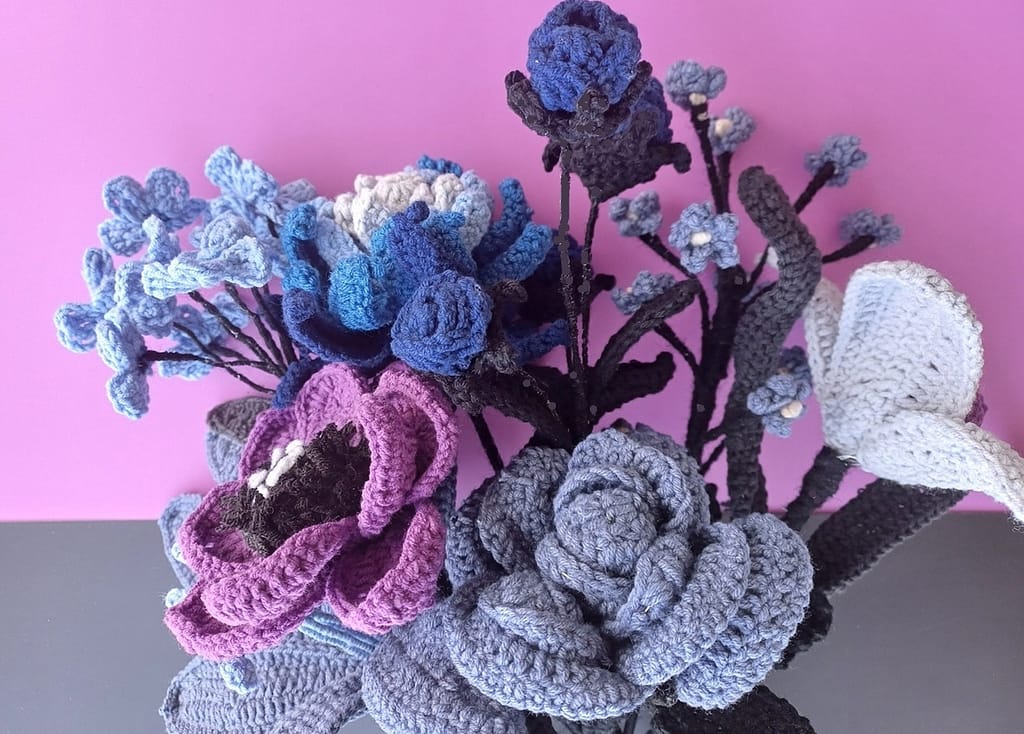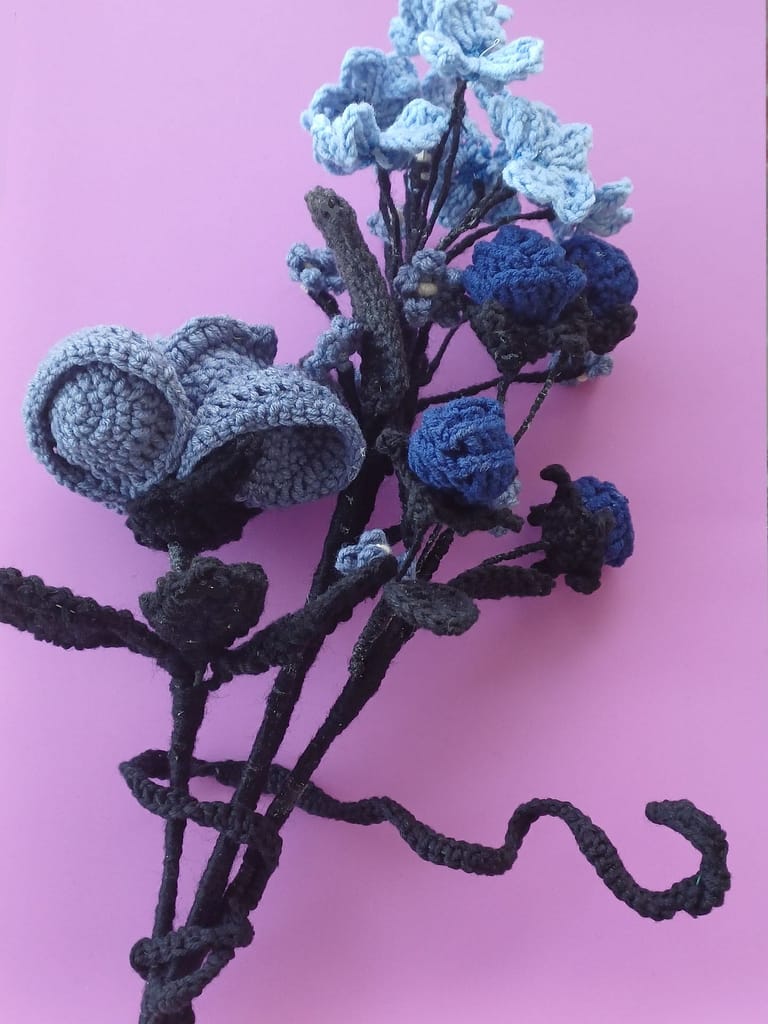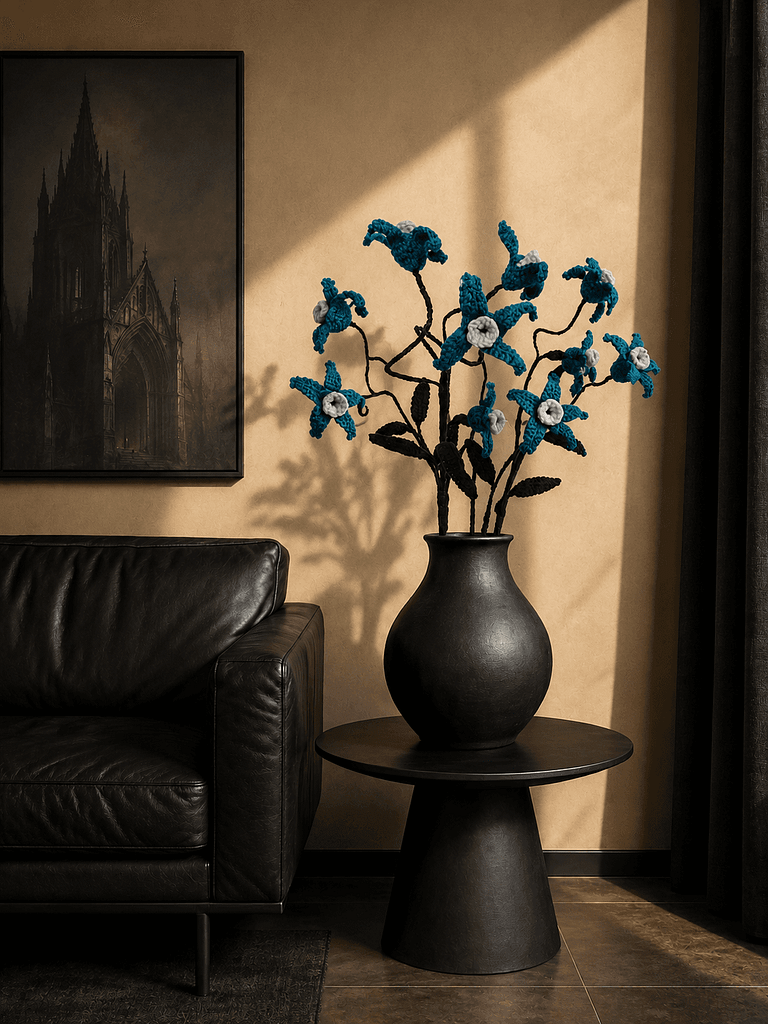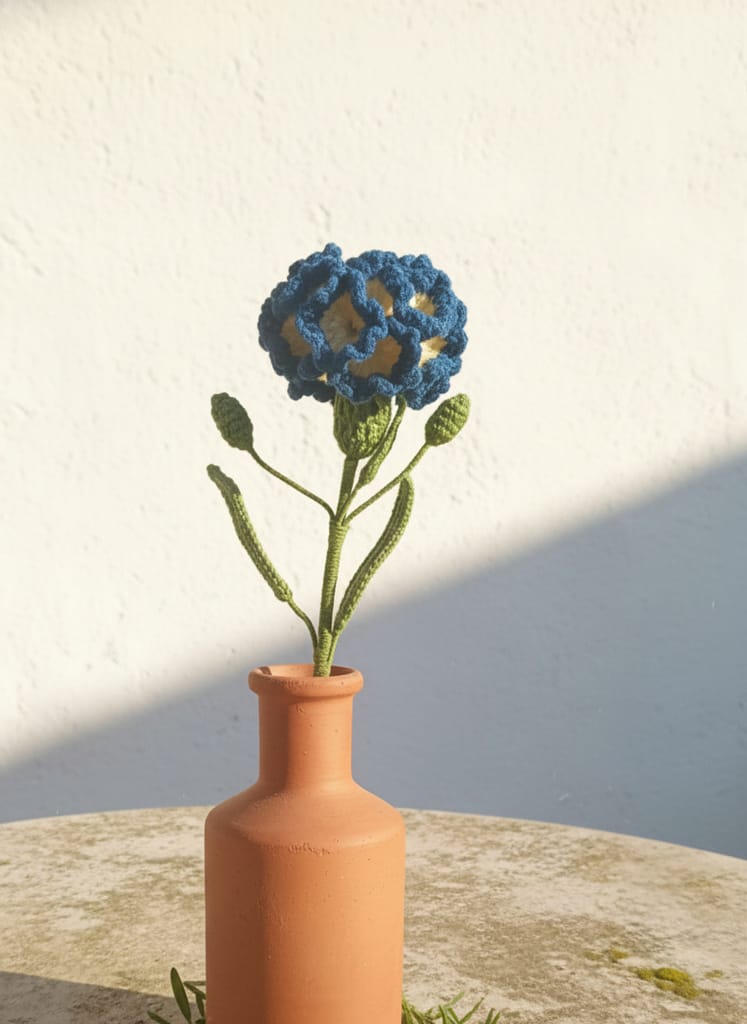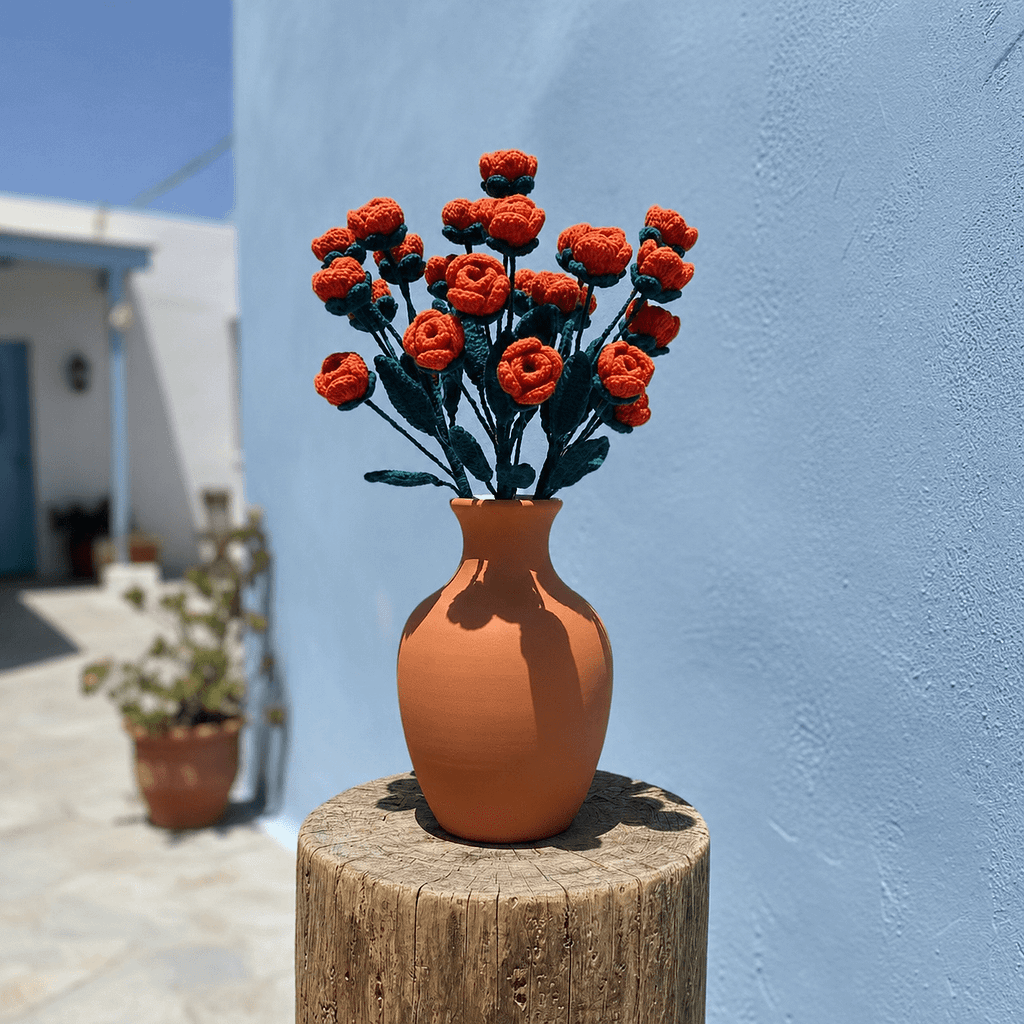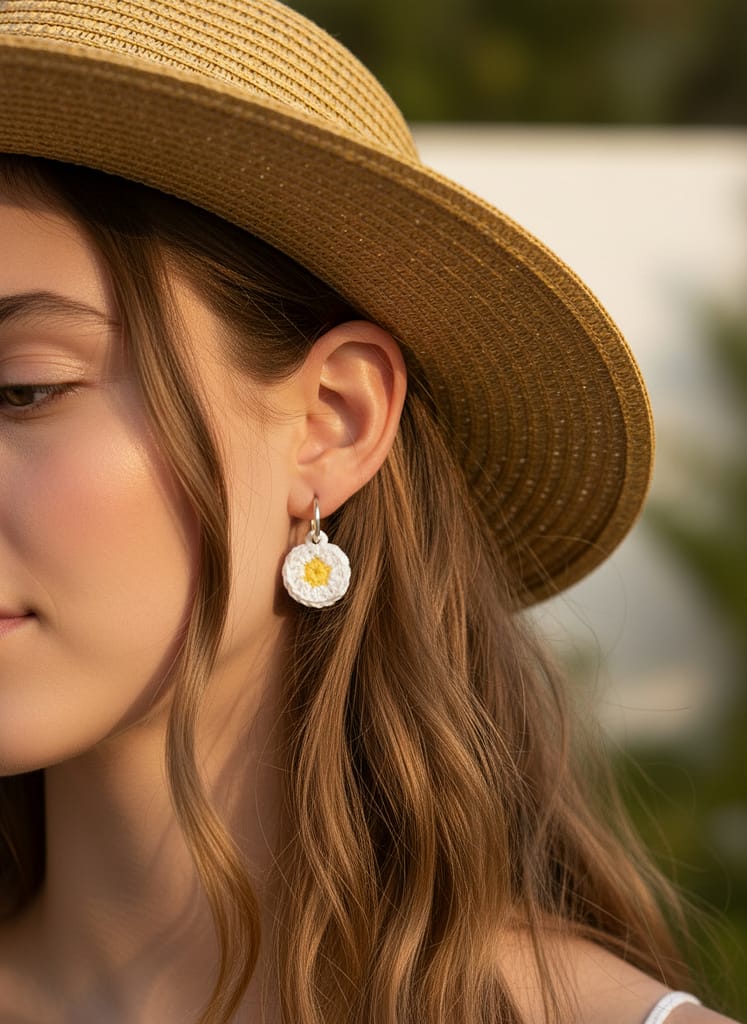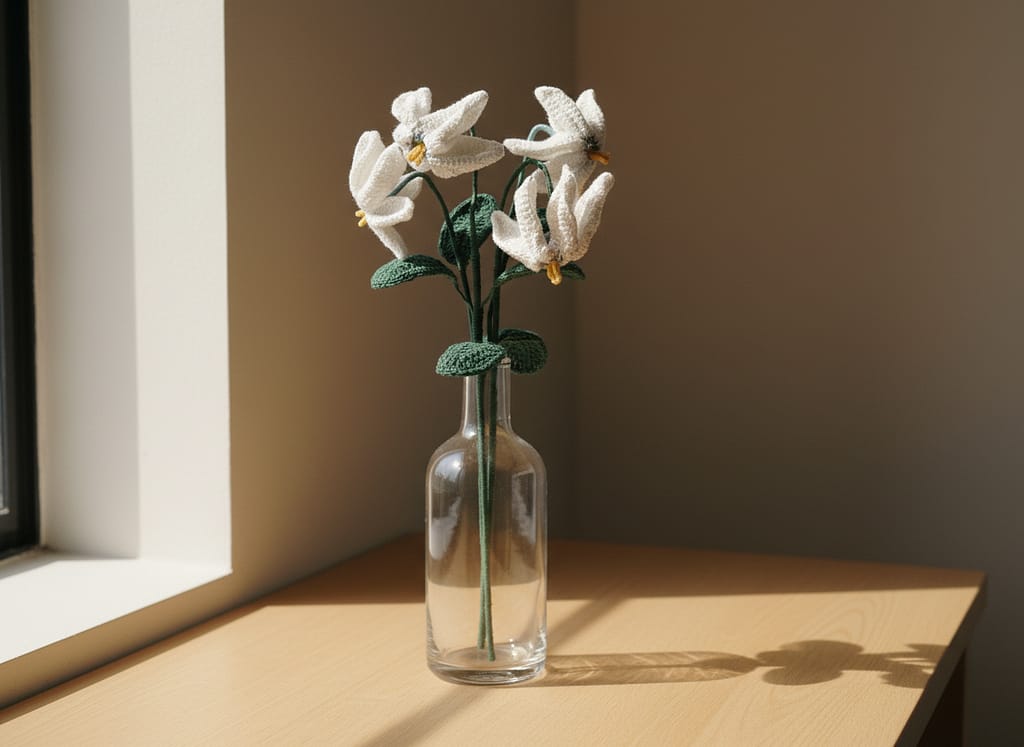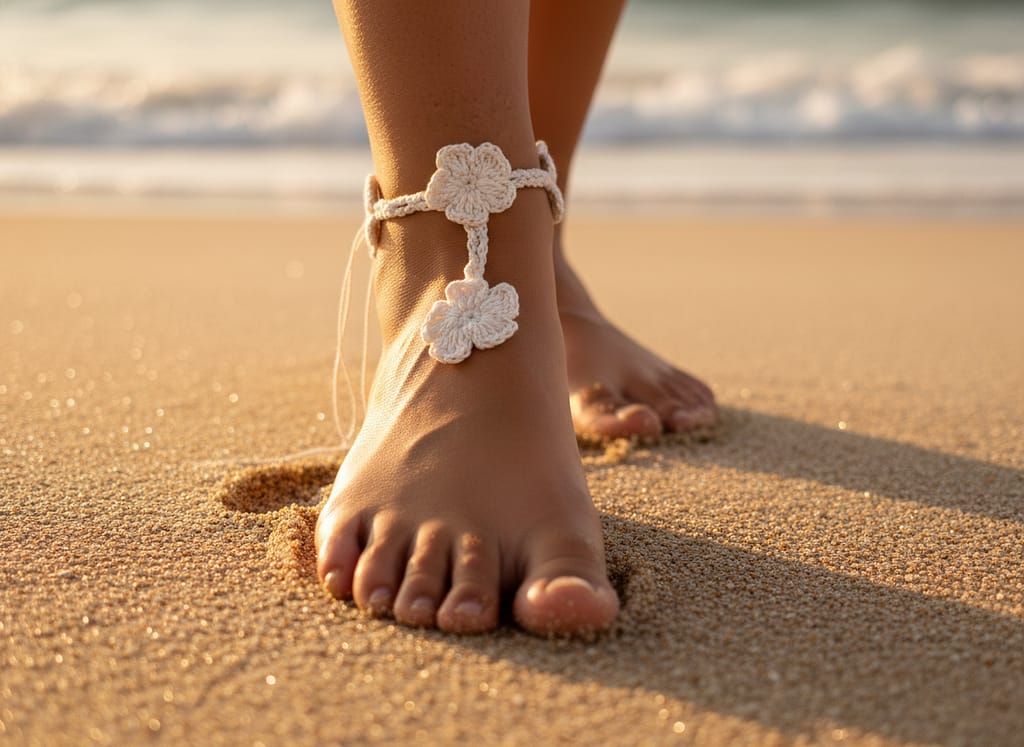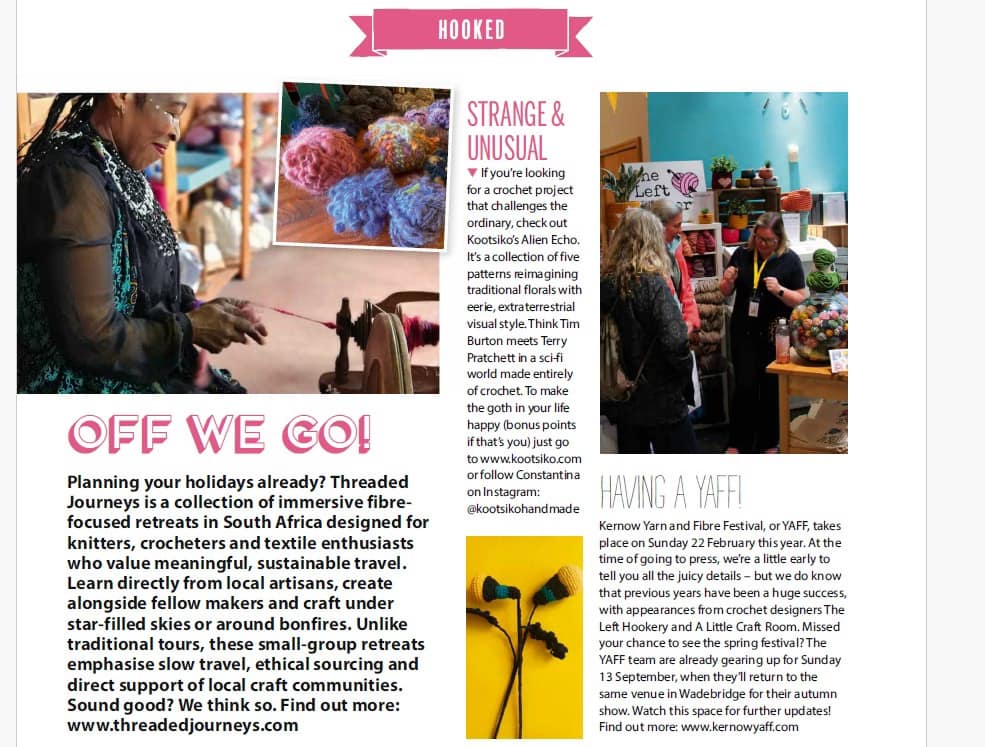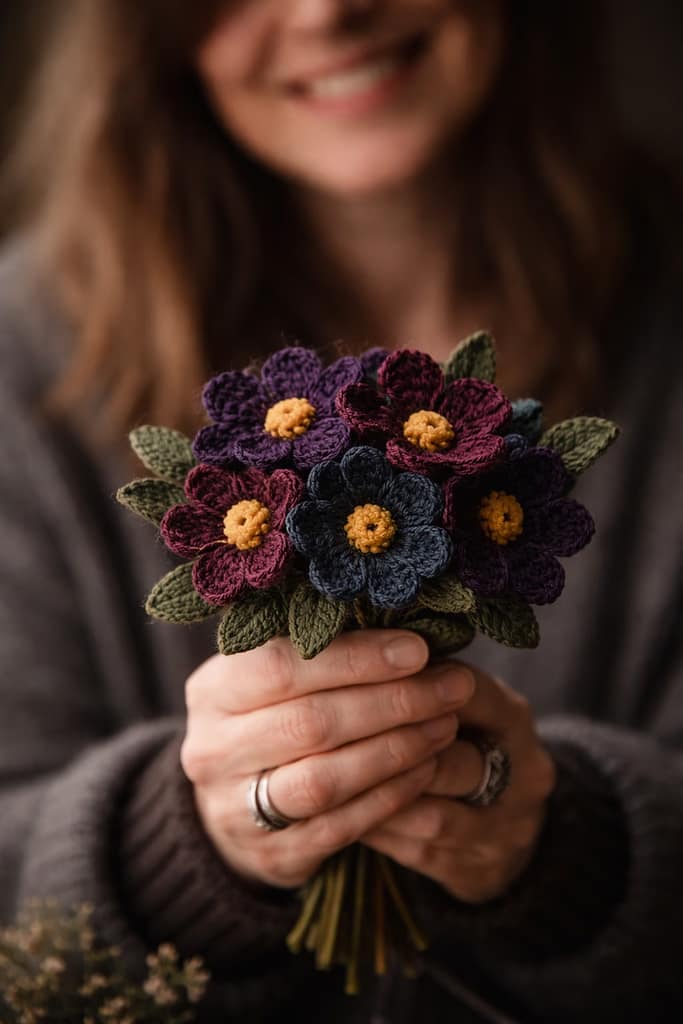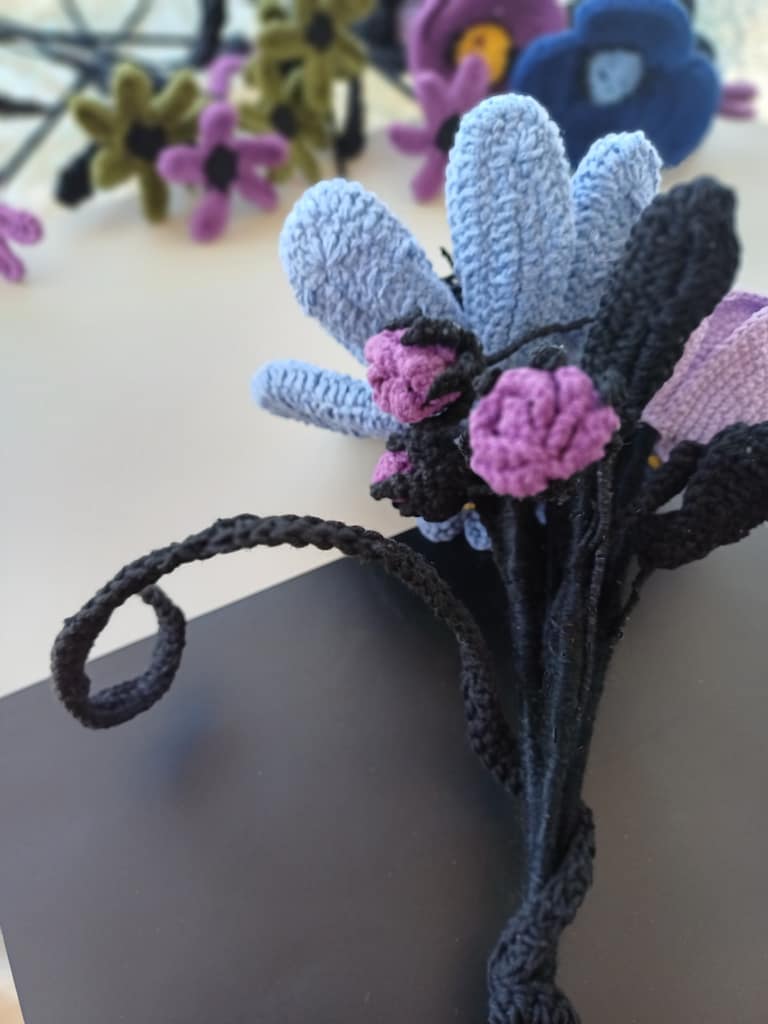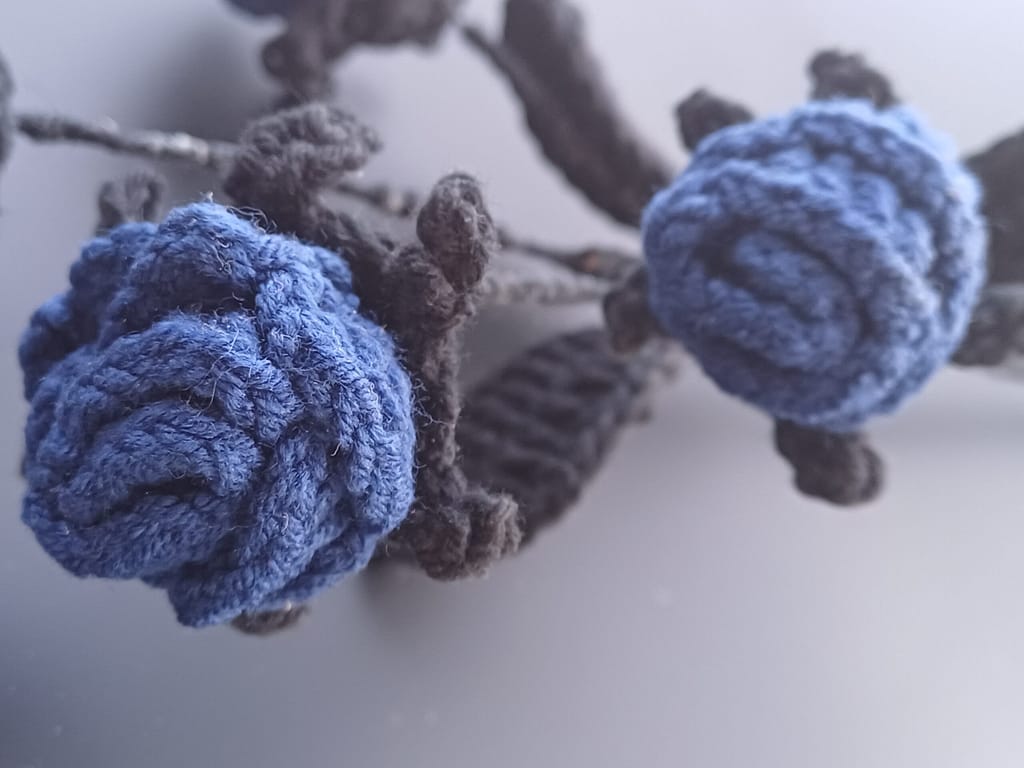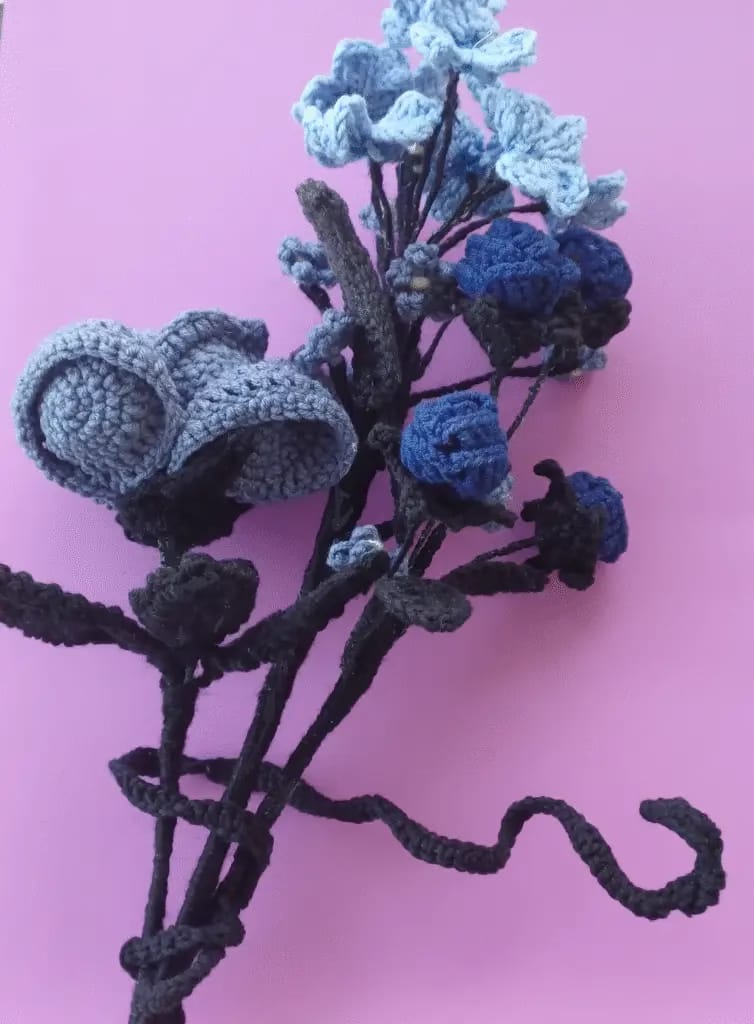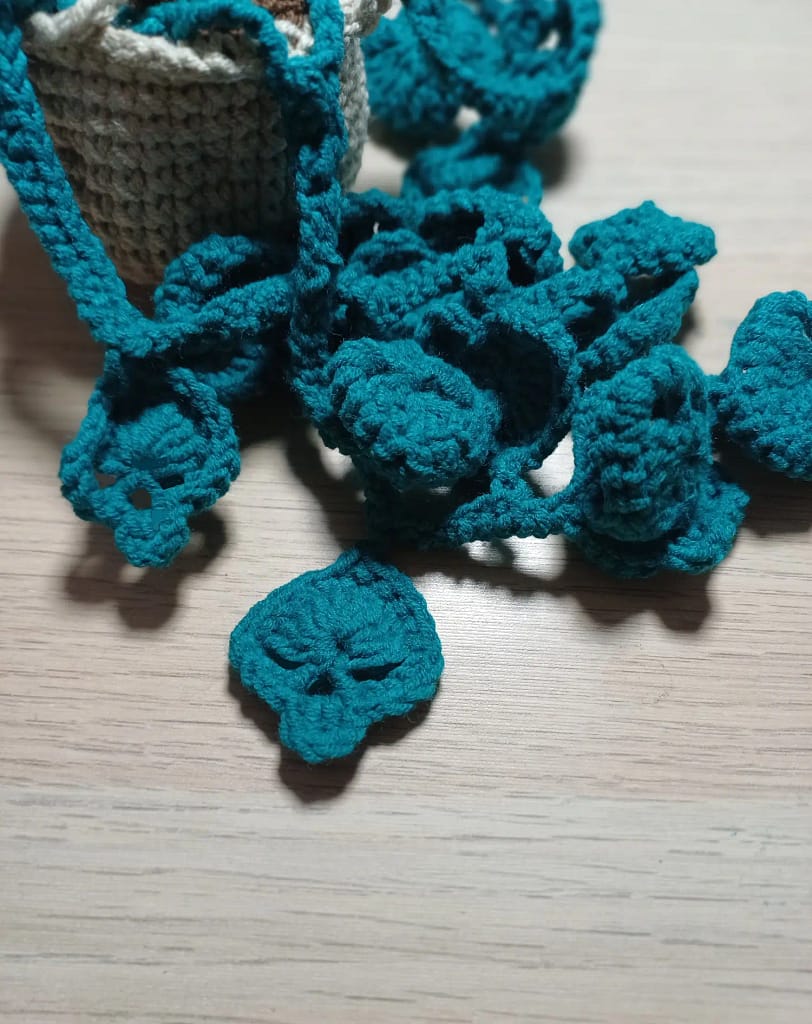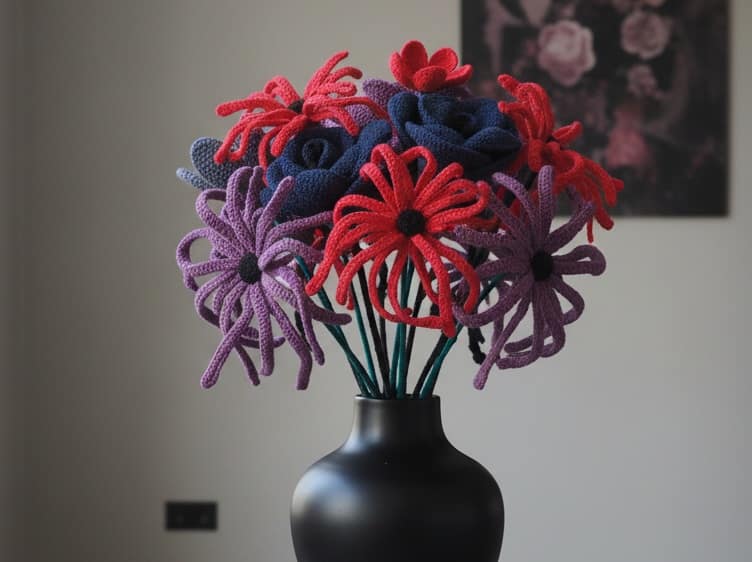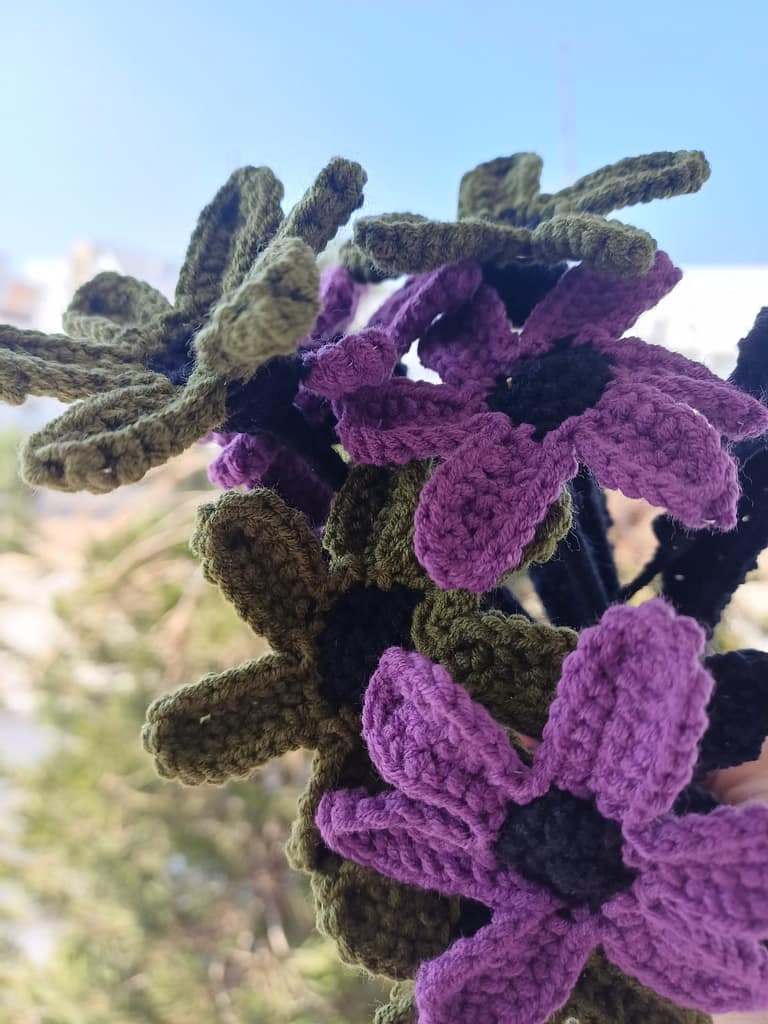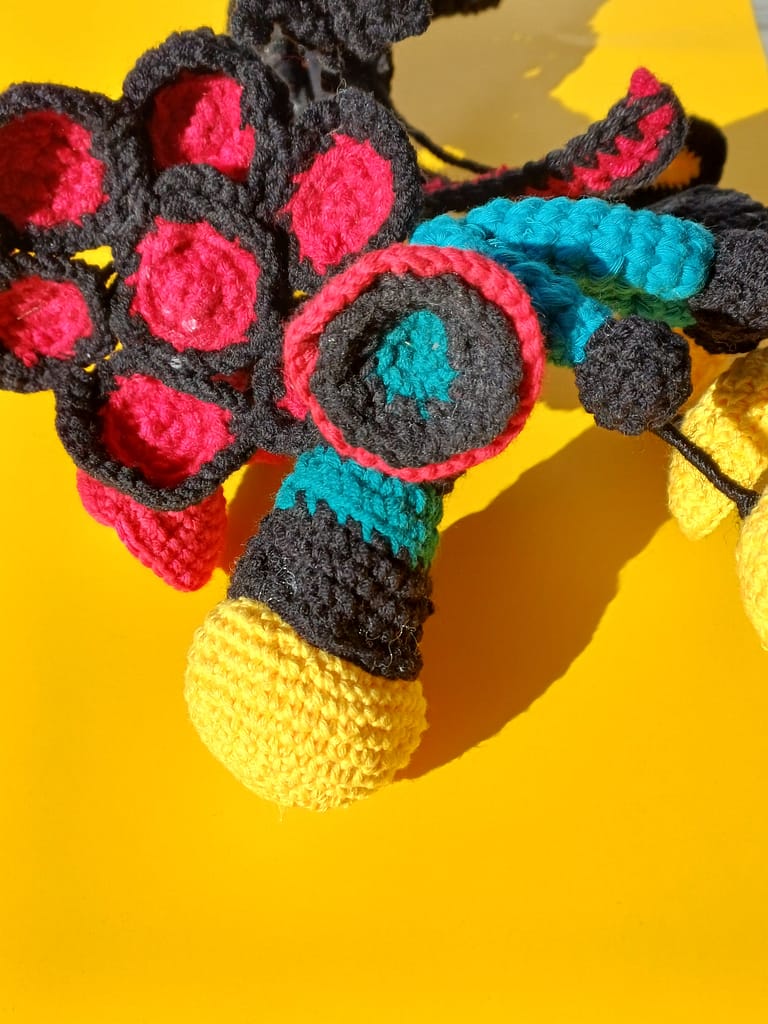
I’m very happy to share a small but meaningful milestone for Kootsiko. My work is featured in Simply Crochet magazine, issue 172.
Simply Crochet is one of the UK’s leading magazines dedicated to modern crochet, a favorite source of inspiration for crocheters around the world, which makes this feature particularly special to me.
Seeing the Alien Echo Collection on an actual magazine page felt both surreal and quietly exciting. Crochet usually lives in a very personal space for me. Yarn, hook, imagination, and many hours of making. Seeing those pieces step into print and reach new readers is something I will always remember.
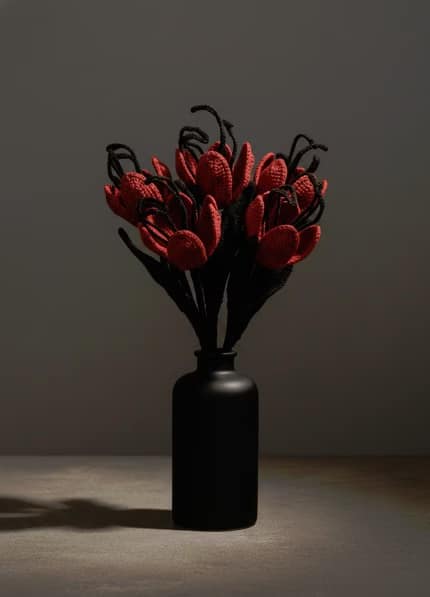
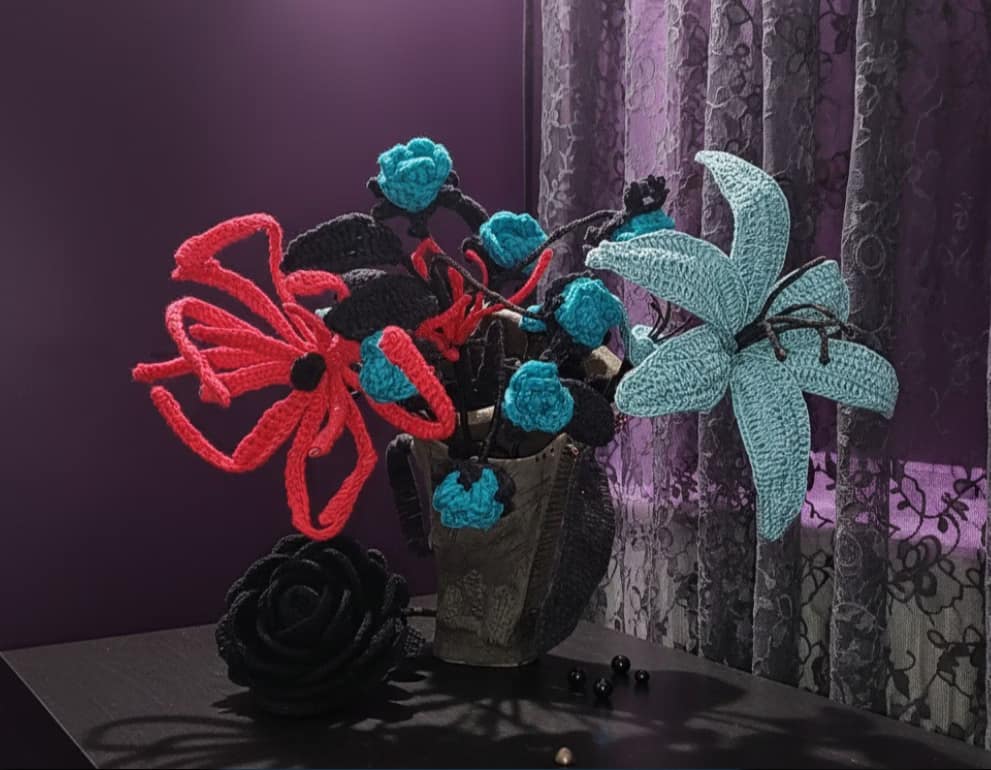
Alien Echo Collection was inspired by my love of dark fantasy and unusual beauty, drawing on influences from Terry Pratchett’s imaginative worlds and the visual style of Tim Burton. The collection explores the idea that crochet can be expressive, sculptural, and a little unexpected.
I’m very grateful to the Simply Crochet team, and especially to production editor Tricia Fairburn, for their kindness and enthusiasm throughout the process. It was a genuinely lovely experience.
If you discover Kootsiko Handmade Atelier through the magazine, welcome. And if you’ve been here for a while, thank you for being part of this journey. A small step, but a very happy one.
There is something deliciously rebellious about choosing a dark flower.
For centuries, blooms have whispered coded messages. In Victorian floriography, entire love affairs were conducted through petals. A red rose meant passion. A daisy meant innocence. A lily meant devotion. But somewhere along the way, flowers became… predictable. Safe. Pastel.
My garden does not bloom in pastel. In my atelier, flowers grow in shadow. They are gothic, sometimes otherworldly, sometimes touched by alien fantasy. They do not wilt and they do not fade. They are crocheted slowly, stitch by stitch, into symbols you can hold in your hands forever.
If you are choosing one of my flowers, you are not just choosing decor. You are choosing a message. Let’s decode them.
The Many Faces of the Rose
The rose is the queen of symbolism. But not all queens wear the same crown.
The Nocturne Rose speaks of devotion that does not need an audience. It is the rose of midnight conversations and quiet loyalty. It represents love that has endured storms and chosen to stay. This is the flower for long partnerships, soul friendships, and the person who stood beside you when things were not easy. It does not shout. It remains.
The Lunar Rose carries the energy of cycles and transformation. Like the moon, it waxes, wanes, and returns. It symbolizes rebirth,intuition, and feminine power. This rose belongs to new beginnings, birthdays that feel like chapters turning, and moments when someone is stepping into a new version of themselves. It is soft, but not fragile.
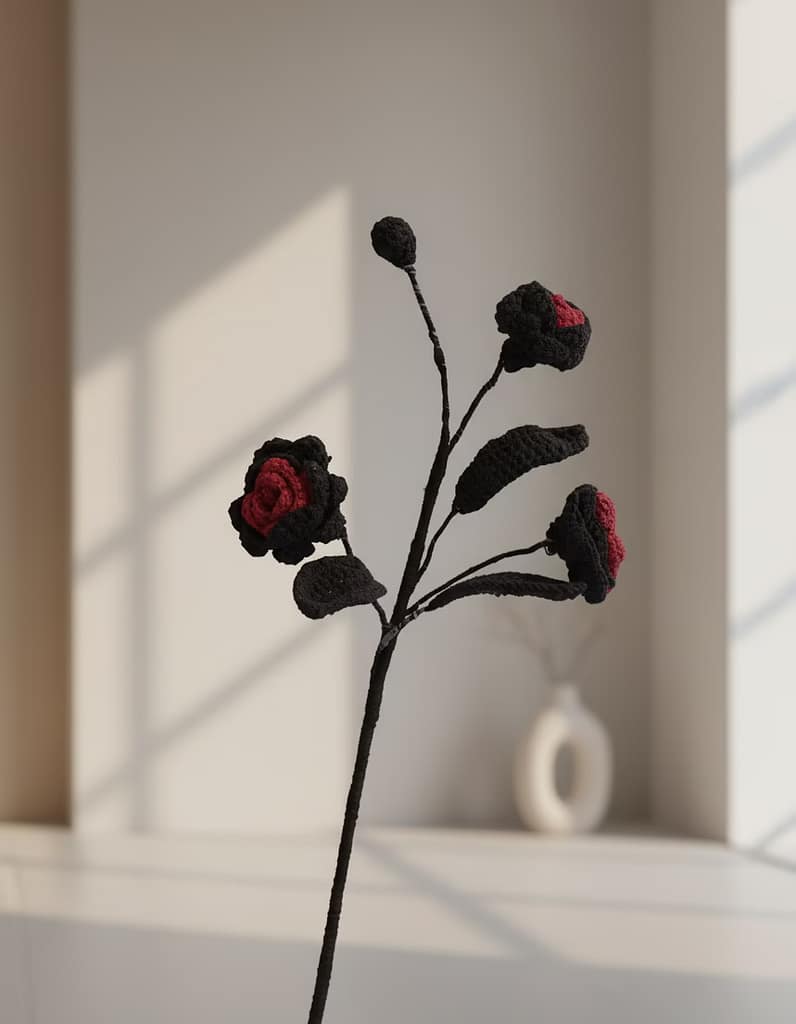
The Gothic Rose is bold love. Dramatic. Unapologetic. It represents passion that refuses to be diluted. It is perfect for the dark romantic, the creative soul, the rule breaker who loves intensely and lives vividly. This is not a flower that blends into a room. It claims space.
Traditionally, tulips symbolize perfect love. My Shadow Tulip keeps the love, but adds depth.
It represents feelings that are powerful but not loud. Emotion held with dignity. Strength wrapped in softness. It is for the person who does not reveal everything, yet feels everything. The one whose silence is never empty. In a bouquet, it adds restraint and mystery, like a secret folded into petals.
Lilies have long symbolized devotion and purity. In darker tones, they shift into something more regal, almost ceremonial.
The Midnight Lilium represents sacred femininity, elegance, and unwavering devotion. It is a flower of presence. Of someone who has learned their worth and stands in it calmly. This is the bloom for mothers,mentors, women rebuilding their lives, or anyone reclaiming their power without needing applause.
The Forget Me Not has always symbolized remembrance and enduring connection. In crochet, its meaning deepens. It cannot wither. It cannot be forgotten by time. It becomes a promise made tangible.
This is the flower for long distance friendships, memorial gestures,anniversaries, and quiet “I am still here” moments. It is small, but it carries the weight of memory.
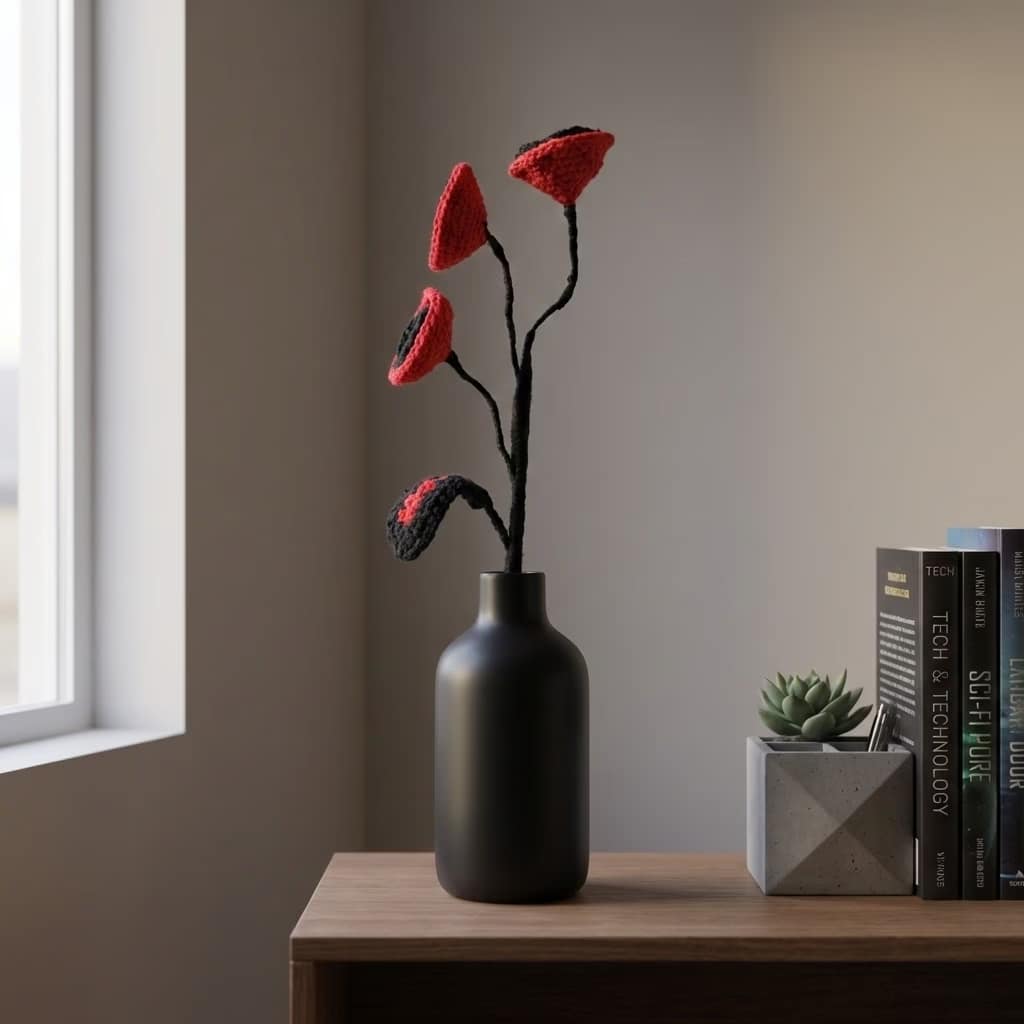
The poppy traditionally speaks of sleep, dreams, and remembrance. The skull transforms it into something more confronting and more honest.
The Skull Poppy is a memento mori. A reminder that life is fragile, and because it is fragile, it is precious. It represents survival,awareness, and the courage to look directly at mortality and still choose beauty. It is a powerful gift for someone who has endured loss, crossed a difficult threshold, or come out the other side of something life altering. It does not romanticize pain. It acknowledges it and blooms anyway.
The anemone has long been associated with protection and anticipation. In darker hues, it becomes the guardian of the heart.
It symbolizes someone who has been hurt but continues to hope. Someone cautious yet open. It is the flower of emotional resilience. In a bouquet, it adds tension and tenderness at the same time.
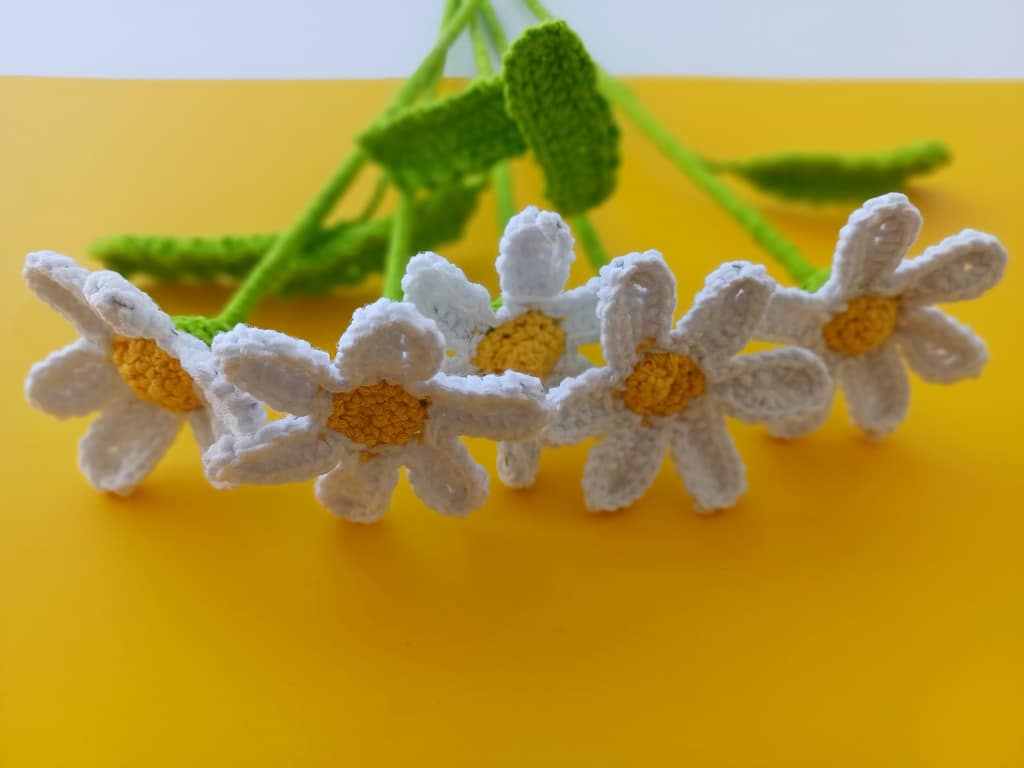
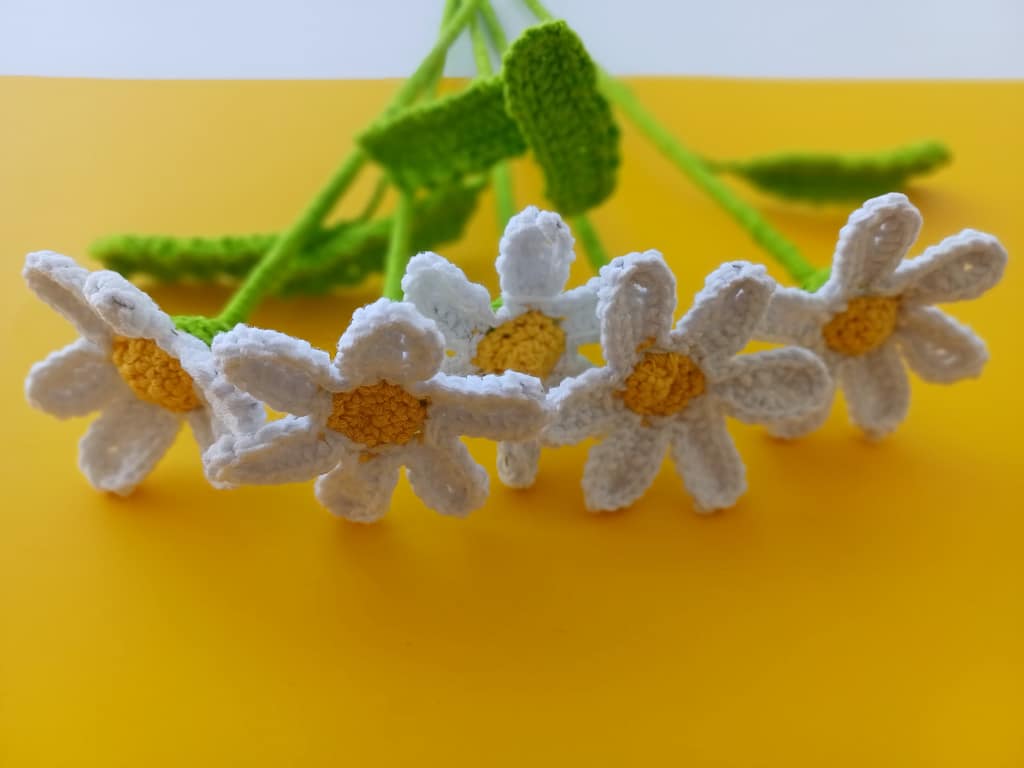
The daisy is innocence. Simplicity. Joy. But in a gothic bouquet, the daisy becomes almost ironic. It represents softness in a world that is not always soft. It is for the person who keeps their humor even when life becomes complicated. The one who smiles, knowing more than they show. A dark daisy is optimism with sharp edges.
Also known as the daffodil, narcissus traditionally symbolizes rebirth and renewal. Wicked Narcissus, represents self recognition. Stepping into your own lightafter living in shadow. It is the flower of personal growth, career changes, therapy breakthroughs, and self love that does not apologize. It marks the moment someone says, “I know who I am now.”
Inspired by myth, Medousa is transformation embodied. Where others saw a monster, mythology reveals a woman turned powerful through pain. This flower symbolizes protection, fierce presence, and unapologetic identity. It is for someone who has survived being misunderstood and turned that experience into strength. In a bouquet, Medousa does not soften itself. It stands.
The Gothic Alien and Alien Fantasy Botanicals
Then there are the bizarre flowers that do not exist in any historical floral dictionary. Xythera, Lunora, Umbra, Nyra and Vocira belong to a gothic alien or alien fantasy world. They are not bound by tradition. They carry meanings you choose.
Xythera represents creative rebellion. The unfamiliar path. It is for artists, innovators, and those building something innovative, that did not exist before.
Lunora embodies dream logic and intuition. It belongs to writers,sensitive souls, and those guided by inner tides rather than external noise.
Umbra is shadow integration. It symbolizes embracing the parts of yourself you once tried to hide. A flower for deep personal evolution.
Vocira represents voice and expression. It is for someone learning to speak their truth without shrinking.
These blooms feel as if they grew under a different sky. They are for people who never quite fit into neat categories and never wanted to.
Crafting a Bouquet with Intention
When you combine these flowers, you are composing a message. A Nocturne Rose with a Skull Poppy speaks of love after survival. A Midnight Lilium with Forget Me Not becomes devotion across time. A Narcissus with Umbra marks transformation through shadow. A Gothic Rose with Medousa creates a bouquet of fierce, unapologetic presence.
Because they are crocheted, these flowers do not fade. The symbolism remains visible. Permanent. Tangible.
In a world of supermarket bouquets that last a week, a symbolic crochet flower becomes something else entirely. It becomes a statement. A memory. A story.
When you choose one of these blooms, you are not just gifting a flower. You are gifting a meaning that refuses to wilt.
Most of us don’t decorate badly. We decorate quickly. We choose what feels familiar, what we’ve already seen a hundred times, what we know how to pick without stopping to think too much. The default option is comforting. It saves time, removes friction, and helps us move on with our day without having to make another decision.
The only problem is that those choices rarely stay with us in any meaningful way. They do the job, they fill the space, and then they quietly fade into the background. And somewhere along the line, decor stops feeling personal and starts feeling automatic.
What “default” really means
Choosing the default option doesn’t make you careless or unoriginal. It usually just means you went with what was easy instead of taking a moment to decide what actually felt right.
Default choices happen when something is available, expected, or requires the least amount of pause. They solve the immediate need, but they rarely create an emotional connection. They fill a space, mark an occasion, do their job, and then quietly disappear, either physically or in your memory.
Why default choices feel safe
There’s comfort in choosing what everyone else chooses. You don’t have to explain yourself. You don’t risk standing out. You don’t worry about getting it wrong.
Default choices blend in easily. They don’t ask to be noticed or understood. And sometimes, that’s exactly what you want. But over time, constantly blending in can start to feel like you’re slowly erasing yourself just a little.
The difference between taste and intention
Taste is often treated like a talent, something visual and instinctive that you either have or you don’t.
Intention works differently. Intention isn’t about knowing what looks good. It’s about knowing why something belongs with you. An intentional choice might look simple or understated, but it carries a quiet sense of care that default choices rarely do. It shows that you paused, that you noticed, and that you chose on purpose.
Why intentional choices feel personal
When you choose intentionally, the object changes roles. It stops simply filling space and starts participating in it. It becomes part of how a room feels, how a gift is remembered, how a moment settles instead of just passing by.
Intentional choices don’t need to be loud or unusual. They just need to feel considered, and that sense of consideration is what people respond to, even if they can’t quite explain why.
The quiet disappointment of “good enough”
Default choices often leave behind a very specific feeling. Not regret exactly, but something closer to mild disappointment. It’s the kind you don’t complain about and barely acknowledge. The kind that makes you think, this is fine, instead of, this feels right.
Over time, a home or a life built entirely on “fine” can start to feel strangely empty, even if everything looks perfectly acceptable from the outside.
Choosing fewer things, more deliberately
Living intentionally doesn’t mean rejecting convenience altogether. It simply means noticing where convenience has stopped serving you.
Sometimes that means choosing fewer things, but choosing them with more care. Things that feel more anchored, more reflective of who you are and how you actually want to live.
Not everything needs to be intentional, but the things that stay the longest probably deserve a little more thought.
Where handmade quietly fits into all this
This is usually the point where people think intentional choices have to be dramatic. They imagine big lifestyle changes, bold design decisions, a whole new version of themselves.
But most of the time, intention shows up in much smaller, quieter ways. It shows up in the objects you live with every day. The ones you see without really seeing, until one day you realise some of them feel empty and some of them feel strangely comforting.
Handmade pieces tend to fall into the second category. Not because they’re better in any loud or obvious way, but because they carry evidence of a pause. Someone chose the yarn. Someone spent time shaping it. Someone decided it was finished only when it felt right, not when a machine said so.
Even if you never think about the process, you feel the result. The object doesn’t just fill space. It brings a sense of care into it.
Why crochet flowers make sense here
Crochet flowers are a small example of this kind of choice. They don’t shout for attention and they don’t try to be impressive. They simply exist as something made slowly in a world that usually moves very fast.
For people who love handmade things but aren’t makers themselves, they offer a simple way to bring intention into a space without turning life into a project. You don’t need to learn a new skill. You don’t need to invest in a whole new hobby. You just choose something that feels more personal than default.
And that one small decision changes how the object feels in your home. It stops being just decor and starts feeling like something that belongs.
A final thought
This isn’t about choosing differently to impress anyone. It’s about choosing differently so your space feels like it actually belongs to you. If you find yourself tired of default options, it’s not because you’re difficult or picky. It’s because you’re ready for things that feel considered.
And if this way of thinking resonates, you might enjoy my newsletter, where I write about beauty, intention, and the objects we choose to live with.
Or you can explore my crochet flowers whenever you feel like it, not as a purchase you have to make, but as an example of how small, thoughtful choices can quietly change the way a space feels.
There’s a strange moment that sneaks up on you when something that once brought pure joy starts to feel a little too much like work.
You don’t make a big announcement about it. You don’t even complain. You just notice that tiny resistance where there used to be excitement. One day you sigh instead of smile. You postpone instead of enjoy. And somehow, without asking your permission, beauty quietly moves from pleasure to obligation and lands right on your to-do list.
How maintenance sneaks into joy
A lot of beautiful things don’t just show up, they arrive with a whole maintenance plan. You’re meant to water this one, replace that one, keep everything alive, fresh, presentable. Suddenly you’re not just enjoying beauty, you’re managing it like a tiny unpaid internship.
At first, all that effort feels almost romantic. Like proof that you care. Like you’re being the kind of person who pays attention to details. But over time, it starts to add up.
Each task is small, completely harmless on its own. Together though, they create this constant low-level hum of responsibility that never really switches off. And before you realize it, beauty becomes something you maintain instead of something you simply experience.
The emotional cost no one talks about
That’s usually when guilt quietly enters the room. Not dramatic, movie-scene guilt. The soft kind. The kind that makes you avoid looking at something because it reminds you of what you didn’t do. The kind that slowly turns enjoyment into pressure. Eventually, the object itself starts to feel heavy, not because it’s asking too much, but because it’s asking anything at all when you’re already tired.
When care becomes performance
Somewhere along the way, we started confusing care with effort. We tell ourselves that if something needs constant attention, it must be more meaningful. That the work we put into it somehow justifies its place in our lives.
But care doesn’t have to be performative. It doesn’t need constant action to prove its worth. Sometimes care looks like choosing things that don’t demand more than you can realistically give.
The relief of low-demand beauty
There’s a special kind of calm that comes from objects that simply exist well. They don’t need checking on, managing, or babysitting. They don’t punish you for being human and occasionally forgetting things.
Low-demand beauty doesn’t disappear if you look away for a while. It waits. Quietly. Patiently. Completely unbothered. And somehow, in doing that, it gives you something rare, permission to rest.
Redefining responsibility
Responsibility feels good when you choose it. It feels exhausting when it’s silently assumed. Not everything in your space needs your ongoing attention to earn its place. Some things are allowed to be there without asking anything back. That’s not laziness. That’s discernment.
Why permanence can feel like kindness
Objects that stay don’t compete for your energy. They don’t rush you or keep reminding you that time is passing and you’re falling behind.
They become part of the environment that holds you, instead of something you constantly have to hold together. There’s real kindness in that kind of permanence, especially in seasons of life where your energy is already fully booked.
Choosing ease without giving up beauty
We often mistake ease for indifference, but ease can be deeply intentional. Choosing beauty that asks less of you isn’t lowering your standards, it’s aligning them with real life. You can love beautiful things and still want them to be gentle with you.
A final thought
Beauty should soften your days, not complicate them. It should make your space feel calmer, not busier.
If you ever find yourself resenting the care that beauty requires, that’s not a failure, that’s information. And if this way of thinking resonates, you might enjoy my newsletter, where I write about choosing beauty that actually fits real life. Or you can explore my crochet flowers, made for people who love the aesthetic without the emotional rollercoaster. No upkeep required. Just presence.
Disposable Beauty Is Tiring. Here’s Why I Chose Something Else
There’s a moment that happens every time you buy something beautiful and temporary. It’s subtle and easy to ignore.
You place it where you can see it. You enjoy it. And somewhere in the back of your mind, you already know how this ends.
Fresh flowers do this especially well. They arrive full of promise. They brighten a room instantly. They make everything feel softer, warmer, more intentional. And then, quietly, they start their countdown.
This isn’t a post against flowers. I love flowers. That’s the problem. I just grew tired of the cycle that comes with them.
The quiet exhaustion of disposable beauty
Disposable beauty doesn’t announce itself as exhausting. It disguises itself as normal. Replacing things often feels harmless. Even pleasant at first. But over time, it creates a rhythm that’s hard to unhear: Buy. Enjoy. Watch fade. Replace.
It’s not just about waste. It’s about attention. Each replacement asks for a decision. Each decision asks for time. Each time you repeat the cycle, beauty starts to feel like something you’re managing rather than enjoying. You don’t notice it immediately. But one day you realise that even beautiful things have started to feel… demanding.
When beauty comes with a deadline
Temporary beauty carries an unspoken urgency. Enjoy this now and make the most of it. Before it’s gone. That pressure seeps into your space. Into your mood. Into how you relate to the object itself. Instead of feeling grounded, you’re slightly on edge. Instead of calm, there’s a low hum of “I’ll need to deal with this soon.”
It’s a strange thing, to feel guilty toward something that was meant to bring you joy. And yet many of us do.
What changes when beauty doesn’t expire
Lasting beauty behaves differently. It doesn’t rush you, it doesn’t ask to be replaced and it doesn’t demand attention to justify its presence.
When something stays, it earns its place slowly. It becomes familiar. It absorbs meaning. It turns into part of the background of your life rather than a temporary highlight. There’s comfort in that. You stop managing beauty and start living with it.
The relief of permanence
There’s a particular kind of relief that comes from knowing your space will look good tomorrow. And next month. And next year. Not because it’s trendy. Not because you’ve kept up. But because you chose something that wasn’t designed to disappear. That relief isn’t dramatic. It’s quiet. But it lingers. It’s the absence of urgency, the absence of guilt and the absence of another thing that needs replacing.
A softer definition of value
We’re taught to measure value in moments. In price tags. In how impressive something looks when it first arrives. But there’s another kind of value that only reveals itself over time. It’s the value of staying power. Of objects that don’t peak and vanish. Of beauty that becomes part of your daily landscape.
When something lasts, you stop asking whether it was “worth it.” The question fades because the object keeps answering it simply by being there.
Choosing differently, not better
This isn’t about rejecting what’s common or familiar. And it’s certainly not about doing things “right.” It’s about noticing what drains you, quietly. If replacing things often leaves you tired rather than inspired. If temporary beauty makes you feel rushed instead of calm. If you find yourself craving fewer, better choices rather than constant novelty.
Then maybe it’s not your taste that’s changing. Maybe it’s your tolerance for disposable beauty.
Why I chose flowers that stay
I wanted flowers that didn’t rush me. Flowers that didn’t ask for constant attention. Flowers that could exist in a space without counting down their final days.
I wanted beauty that felt settled. Intentional. Calm. Not because permanence is better than change. But because some things deserve to stay.
A final thought
Not all beauty needs to disappear to be meaningful. Some beauty becomes meaningful because it stays long enough to be lived with. If this way of thinking resonates, you’re probably my kind of person.
You canjoin my newsletter for quiet thoughts like this and early access to new designs. Or you can explore my crochet flowers and see what lasting beauty looks like in your space. No rush. They’ll still be here.
Not every space in your home needs to be bright, productive, or politely cheerful. Some corners are meant to whisper instead of shout. They exist for slow moments, half finished thoughts, and the kind of calm that only shows up when the lights are low and the world finally quiets down.
A moody corner is not about darkness for the sake of drama.It is about atmosphere. About softness, depth, and intention. It is a place that feels held rather than styled, layered rather than decorated. And crochet flowers, especially in darker tones, are perfect for creating that feeling because they bring texture, symbolism, and a sense of permanence that fresh flowers never quite manage.
If you have ever felt drawn to gothic interiors, shadowy palettes, or romantic spaces that feel slightly mysterious, this is for you.
Let’s build a moody corner, slowly and thoughtfully, one stitch at a time.
Step 1: Find a Corner That Wants to Be Quiet
Start by observing your space instead of forcing an idea onto it. The best moody corners are rarely the obvious ones. Look for a place that already feels calm or slightly overlooked. A reading nook near a window, a small table that never quite found its purpose, a shelf in a room where the light softens in the afternoon.
You do not need much. A chair, a side table, or even just a surface that can hold a vase is enough. What matters is the feeling. If the light hits gently, if shadows linger instead of disappearing, you have found a good starting point.
Natural light is welcome, but it should be indirect. Think glow rather than glare. Your crochet flowers will catch the light quietly, creating depth instead of demanding attention.
Step 2: Let the Flowers Lead
Crochet flowers are not just decoration in a moody corner. They are the heart of it. Their shapes, colors, and textures set the tone for everything else.
Choose deeper shades and muted palettes. Black, charcoal, deep red, dusty teal, muted purple, and shadowy greens all work beautifully. These colors absorb light instead of reflecting it, which is exactly what gives the space its softness.
In main photo of this article, the Medousa flower brings movement and tension, almost sculptural in its shape. The Midnight Lilium adds elegance and structure, while the Nocturne Rose grounds everything with weight and quiet drama. Together, they create contrast without chaos, which is exactly what you want.
Mix sizes and forms. Pair something bold with something restrained. A large flower with reaching petals next to smaller blooms creates visual rhythm and keeps the arrangement from feeling static.
Display ideas that work especially well in moody spaces include vintage vases, ceramic containers with texture, dark glass bottles, or even unexpected vessels that look slightly worn. Perfection is not the goal. Character is.
Step 3: Build the Mood in Layers
Mood does not come from a single object. It comes from layers that work together.
Lighting is where everything changes. Avoid anything harsh or overhead. Choose candles, lanterns, fairy lights with a warm tone, or a small lamp with a soft bulb. Shadows are part of the design here, not a problem to solve.
Textures matter just as much as color. Crochet naturally brings softness, so echo that with velvet cushions, woven throws, linen, aged wood, or metal accents with a patina. These materials absorb sound and light, making the space feel intimate and grounded.
Keep the color palette cohesive. You do not need many colors, just variations of a few that speak to each other. Burgundy, forest green, charcoal, deep blue, and black all work beautifully together when layered thoughtfully.
Think of your crochet flowers as the main characters, and everything else as the set design supporting their presence.
Step 4: Add Meaning, Not Clutter
A moody corner should feel personal, almost secret. This is not the place for trends or filler objects.
Choose a few items that hold meaning for you. A book you return to often. A framed quote that feels like a spell. A tarot deck, a crystal, a small object you found while traveling. These things add emotional weight, which is what makes the space feel alive.
This is also a beautiful place to crochet. A corner where you sit with your yarn, your thoughts, and maybe a candle burning quietly beside you. Over time, the space absorbs those moments, and that is something you can feel when you step into it.
Step 5: Let It Change with You
A moody corner is not meant to be finished. Rearrange it when the seasons change. Swap flowers when your mood shifts. Add a new bloom when you complete a pattern that feels special.
Dust it gently, care for it slowly, and allow it to evolve. This is not about perfection or styling rules. It is about presence.
A reminder that beauty does not have to be loud. That handmade things carry energy. That shadows can be comforting.
If you want to create your own crochet flowers for a moody corner like this, you can find my patterns in my shop. They are designed to be expressive, a little dark, and full of character, perfect for spaces that bloom best away from the spotlight.
Claim your corner. Let it hold your flowers, your craft, and your quiet moments. And let it bloom, softly, in the shadows.
Real flowers are beautiful… for about three and a half days. Then the water turns questionable, the petals droop dramatically like Victorian heroines, and suddenly you’re left with a vase full of guilt and soggy disappointment. And if you’re anything like me, you’ve probably whispered “but I just bought you…” to a dying rose more than once.
Yes, I’m biased. But I’m also right.
Crochet Flowers Last Forever (and Ever)
One of the universal truths of life is this: real flowers die, and crochet flowers don’t.
A crocheted bouquet doesn’t wilt, doesn’t turn brown, and doesn’t crumble the moment someone opens a window too aggressively. These blooms stay exactly as you bought them. A week later. A month later. A year later. Ten years later, if you treat them nicely.
They’re the closest thing to immortal flora your home will ever meet. Goth energy? Absolutely.
Crochet Flowers Are Actually Sustainable
Fresh flowers look innocent enough, but their footprint is surprisingly large because in many cases they are: ⚬ Imported from far away ⚬ Refrigerated during transport ⚬ Wrapped in plastic ⚬ Tossed out within days
Crochet flowers, on the other hand, are handcrafted in small batches, not mass-produced, not refrigerated, not flown across continents in giant temperature-controlled trucks. And because they last, you don’t have to replace them every week.
That alone makes them a greener choice, especially if you’re trying to bring more mindful, sustainable habits into your home.
Crochet Flowers Are More Affordable in the Long Run
Sure, a handmade bouquet may cost more upfront than the supermarket roses that come pre-wilted. But think long-term: A real bouquet lasts days. A crochet bouquet lasts… well, until you lose it or give it away.
If you’re someone who loves having flowers in your home, on your desk, dining table, bedroom, bathroom, everywhere, a one-time purchase that lasts forever and quietly saves you money over time. It’s like a subscription to beauty, but with only one payment.
Crochet Flowers Demand Zero Maintenance (Truly Zero)
Let’s be honest: real plants are not always forgiving. You forget to water them, they collapse. You water them too much, they collapse. You look at them weird, they collapse.
Crochet flowers? They ask for nothing. They sit there, perfectly pretty, giving main-character energy without requiring the emotional labor of keeping them alive. Dust them occasionally, and they’ll love you back forever.
Crochet Flowers Are Personal, Customizable, and Full of Story
Every crochet bouquet is handmade, which means no two are ever exactly the same. You can choose: the style, the colors, the mood (romantic, goth, whimsical, alien… we respect all aesthetics), the size, and even the vibe of the arrangement.
Want big black roses? Midnight lilies? A bouquet inspired by your favorite book character? A colorful set that matches your living room palette? Done. Try asking that from a florist without getting that look.
Crochet Flowers Make Unforgettable Gifts
Most gifts are politely appreciated and forgotten. A handcrafted crochet bouquet? Never forgotten. They feel intentional, thoughtful, personal.
They say: I wanted something that lasts. And they fit every occasion: birthdays, housewarmings, anniversaries, Valentine’s, goth weddings (yes please), Mother’s Day, apology gifts, or “I saw this and thought of you.”
Unlike real flowers, they won’t be binned three days later. Your love doesn’t deserve the bin.
Crochet Flowers Are Beautiful Blooms, Guilt-Free
Crochet flowers mean no waste, no wilting, no weekly repurchasing, no environmental “oops,” and no sadness when the petals give up on life. Just beauty that stays with you.
So if you love flowers but hate the heartbreak of throwing them away, it might be time to let sustainable, handmade blooms into your home. And let them stay there forever.
Medousa crochet flower appeared while I was daydreaming about alien gardens, Discworld jokes, and the Avatar flora. It is a flower that can look sweet & spooky.
Give Something Unique, Meaningful, and Actually Worth Giving
We’ve all been there: a birthday sneaks up on you, your cousin announces a surprise engagement, your best friend gets promoted, or you suddenly remember that your coworker does expect a Secret Santa exchange even though everyone pretends they don’t.
And then it hits you…
What gift do I get?! You want something thoughtful, you want something unique, and—let’s be honest—you want something that won’t scream “I panicked in the supermarket aisle at 9 pm.” If your budget is whispering “please don’t do this to me,” but your heart wants to give something special, this gift guide is for you.
Below are 5 amazing handmade or DIY gift ideas you can create on a budget, plus 5 unique crochet-flower options from my Kootsiko universe whether you are the crocheter or them. Every idea is chosen to be memorable, personal, and the kind of thing people actually keep.
Thrifted teacup candle✨ These vintage teacups were way too pretty to leave behind—so I turned them into the coziest little candles 🕯️💖 A sweet and simple DIY that’s perfect for gifting, girls’ night, or just treating yourself. #diycandles#DIY#candlemaking
This is one of those gifts that looks fancy but takes very little effort. Buy it or spend even less money if you make it yourself. All you need is soy wax, a wick, a little fragrance oil, and a thrift-store teacup. That’s it.
Why it’s great:
Looks boutique-level without boutique prices Customizable with colors, scents, and container style Perfect for birthdays, thank-yous, or housewarmings
Pro tip: Add a handwritten tag that describes the scent. Suddenly it feels like a premium candle you’d find in a lifestyle boutique.
If you want something modern, stylish, and a little artsy, concrete planters are chef’s kiss. You can buy or make them using inexpensive concrete mix and plastic containers as moulds. Swirl in acrylic paint for that marbled finish that makes people say “Wait… you MADE this?”
Why it’s great:
Trendy and gender-neutral Affordable materials Matches almost any decor Ideal for plant lovers (or fake-plant lovers)
Pro tip: You can even slip in a tiny succulent for bonus points.
Honestly, everyone needs one. And people love receiving personalized ones even more. Grab a plain canvas tote, some fabric paint, stencils if you want, and go wild. You can paint their pet, their favorite color palette, a cute phrase, or something abstract if drawing isn’t your thing.
Why it’s great: Eco-friendly Lightweight to wrap or mail Totally customisable Looks store-bought if you take five minutes to iron it afterwards
It’s the kind of gift that’s used almost daily, and that’s the goal!
Beeswax wraps are the perfect low-budget, high-impact gift for anyone who loves cooking, sustainability, or Pinterest aesthetics. All you need is cotton fabric, beeswax pellets, an oven, and ten spare minutes.
Why it’s great: Practical Reusable Beautiful when paired with patterned fabric Impressive even though it’s extremely easy Bundle three in a ribbon and you have a gorgeous handmade gift set.
Pro tip: They can be used exactly as plastic wraps to wrap food, seal jars, but also as beautiful snack pouches.
This idea works for anyone, and you can tailor it to their personality. Create a diy sketchbook and add it in a mini box with small items like a nice pen or brush pen, a snack and a candle. Perfect for stressed friends, teens, creators, colleagues, and honestly… anyone who deserves a cozy night.
Why it’s great: It looks curated, thoughtful and feels like a gift that encourages relaxation and creativity.
Is the Crocheter You, or the Person You’re Gifting?
Whether you are the crocheter or the person receiving the gift, the solution is simple: Make a stunning forever-blooming flower, or gift the digital pattern so they can create their own magic!
If you are a crocheter, you know that flowers don’t need much time or yarn. And also, you don’t need to be an experienced crafter to make a gorgeous handmade flower or bouquet. But even if you don’t crochet and they do, digital patterns are an amazing present, especially for creative people who love to crochet, or want to start.
These are great for: Friends who love making things People who kill real plants (but want the aesthetic) Besties with love for the strange Fantasy lovers Anyone who likes pretty things without the maintenance
Here are three Kootsiko gift picks:
Medousa Bloom Crochet Pattern
Make one or gift someone a pattern for a flower that looks like it escaped from a myth. The Medusa Bloom crochet pattern creates a dramatic, sculptural flower with twisting, snake-like petals that look straight out of a fantasy tale.
It’s the perfect gift for someone who loves mythology, dark aesthetics, or statement decor.
Print the pattern, pair it with a beautiful yarn in purple, red or even black and bundle it as a DIY kit. It feels personal, creative, and unforgettable. The kind of gift people talk about.
It’s a gift that says, “you know me sooo damn well”!
Gothic Rose Crochet Pattern
Perfect for the goth bestie, the chic aunt, the romantic couple or the nerdy colleague. One pattern, endless stunning results because this rose is incredibly flexible. Change the colors, mix two shades for contrast, fold the petals inward, or even keep fewer petals. Every variation blooms into a gorgeous, completely unique rose that never dies!
The perfect symbol of eternal friendship, romance, or chaotic optimism.
Vocira Crochet Pattern
The optimistic one in your Strange Botany universe and part of the Alien Echo Collection. Vocira makes a wonderful gift for anyone who loves fun and unique handmade pieces.
You can crochet it yourself and present it as a one-of-a-kind keepsake, or gift the digital pattern to a crafty friend who would enjoy making their own.
Bright, cheerful, and beautiful, this pattern is an affordable, and a thoughtful gift for anyone who needs a little happiness… or a new hobby!
💐 Extra Handmade Gift Idea: A Custom Crochet Bouquet
A crochet bouquet is the kind of gift that stops people mid-sentence. It’s beautiful, durable, and full of meaning.
Choose 3–5 flowers (or use your own signature mix), crochet them in the recipient’s favorite colors, and wrap them in kraft paper, a vintage ribbon or a… Spellvine!
This affordable and sustainable gift works for birthdays, engagements, graduations, and even as home decor. Plus, it’s a “forever gift”. No watering, no wilting, just pure handmade charm.
🎁 Final Thoughts
Giving gifts shouldn’t feel stressful, expensive, or last-minute. A thoughtful DIY or a unique crochet pattern shows you care, even when your budget is saying “can we please calm down?”
Whether you choose a handmade candle or one of my immortal yarn flowers, your gift will be meaningful, memorable, and totally not boring.
Want more gift ideas or pattern suggestions for all your future gifts?
Every year it’s the same story. You promise yourself you’ll plan Christmas early. That this time you’ll avoid the panic of last-minute shopping and the awkward dance of pretending to love socks. And yet, here we are again.
If the idea of fighting through crowds and buying stuff that’ll be forgotten by New Year’s makes your soul sigh, here’s a softer rebellion: make your own gifts.
And yes, you still have time.
The handmade kind of magic
There’s something ancient about creating things with your hands. Crochet is part craft, part meditation, part small act of love disguised as yarn. And the result is luxury presents that would cost a fortune to buy from a crocheter.
When you make a gift, you’re not just giving an object, you’re giving time, care, and a little piece of yourself. Every stitch says, I thought of you. I stayed up late. I cared enough to make something that doesn’t exist anywhere else.
And if you’re thinking, “That sounds lovely, but I have zero idea how to crochet,” don’t panic — I’ve got you covered.
Where to start: the gentle entry point
If you’ve ever wanted to learn crochet, the best time to start is now, before the holiday chaos begins. I wrote a post called Your Ultimate Crochet Beginner’s Checklist, which covers everything you need to get started: tools, yarn, the basic stitches, and how to avoid throwing your hook across the room.
It’s not about being perfect. It’s about finding rhythm. Crochet is strangely forgiving. You can mess up, unravel, redo, and it’ll still come together. It’s like therapy that accidentally produces art.
From first stitches to heartfelt gifts
Once you’ve mastered the basics, you can move on to simple projects that make incredible gifts and things that look like they took forever but really just took patience and good music (or Netflix shows).
Start with one of my beginner-friendly patterns. They’re designed for people who can barely tell a single crochet from a slip knot but want to make something striking anyway.
You’ll find dark romantic flowers, alien blossoms, and a few designs that look like they wandered in from another dimension. Perfect for your witchy friend, your weird cousin, or that one person who always prefers mysterious gifts wrapped in black paper.
Before long, you can gather your creations into bouquets, hauntingly beautiful arrangements that never wilt and will absolutely steal the show.
Crochet bouquets: where craft meets art
There’s something theatrical about a crochet bouquet. It’s handmade and emotional, but it’s also dramatic. The kind of décor that stops people mid-sentence.
Picture a dark red rose next to a violet lilium, a mossy green stem twisting around them like it knows a secret.
It’s a love letter, an art piece, and a rebellion against mass production, all in one vase.
And the best part? These flowers last forever. You can give them as gifts or keep them as part of your winter décor — they look just as stunning on a mantle as they do in someone’s hands.
Don’t spend money — spend meaning
You don’t need to empty your wallet to show love. You just need to give your time, your thought, your energy.
Anyone can click “add to cart.”
But it takes intention to sit down, learn something new, and make a gift that’s truly personal.
When your friend unwraps a crochet flower — made by *you* — they’ll know this wasn’t bought in a rush. It’s a story stitched in yarn. It’s time you could have spent scrolling, but didn’t.
Crochet has this quiet way of healing you while you create. You focus. You breathe. You turn a single thread into something alive. By the time you tie that last knot, you’ve given two gifts. One to someone you love, and one to yourself.
So, if you’re craving a slower, more meaningful holiday, skip the store. Pick up a hook, a skein of dark yarn, and a cup of tea. There’s still time to make something beautiful, strange, and completely yours.
Until next bloom, 🌹 Kοotsiko
👉Join the Kootsiko Newsletter and get a mystery flower pattern as a welcome gift! You’ll also be the first to know about new designs, tips, special offers and behind-the-yarn stories.
Some people give roses. Some give chocolates. Here, we prefer gifts that come with a little darkness and a lot of personality. Because hearts and flowers are lovely, sure, but they’re so much more interesting when they look like they’ve survived something.
If you’ve ever looked at a black rose and thought, “Yes, that’s my emotional state in flower form,” welcome home. This guide is for you, and for everyone whose idea of romance involves velvet, candlelight, and maybe a touch of melancholy.
So here are a few ideas for crochet gifts that are beautifully odd, quietly sentimental, and perfect for the darkly romantic.
Eternal blooms for eternal love
Fresh flowers are gorgeous until they start wilting on your table like tiny martyrs. Crochet ones, though, they last forever. No watering, no shedding petals, no heartbreak.
A bouquet of black roses, midnight lilies, or deep violet dahlias makes a statement gift. It says, “I love you, and I am also a bit of a mystery.” Wrap them in black tissue paper, tie with a Spellvine, and tuck in a handwritten note. Make it cryptic. Make it weird. The Victorians would approve.
Crochet flowers also make perfect keepsakes for anniversaries, birthdays, or those “just because you make the world deliciously strange” moments. They never die, and that’s exactly the point.
Moody décor for equally moody souls
If your friend’s home looks like it could double as the set of a gothic romance novel, crochet décor will fit right in.
Picture this: a small arrangement of crochet blooms under a glass dome, a garland of dark flowers trailing across a bookshelf, or a single black Medusa sitting in a thrifted vase. It’s atmospheric. It’s dramatic. It’s what happens when your décor mood board says “witchy tea party, but make it cozy.”
Crochet home décor gifts are thoughtful because they take time. Every stitch carries a bit of energy, intention, and patience. They’re not just pretty; they hum quietly in the background like good music.
Wearable darkness
Accessories are for people who like to bring their personality everywhere, even to the supermarket. Small crochet pieces make stunning wearable gifts. Think a choker with a single black flower, a deep red rose brooch pinned to a coat, or a midnight bloom hair clip. These aren’t just accessories; they’re conversation starters.
They say, “Yes, I crocheted this. Yes, it’s black. No, I’m not in mourning. I just have taste.” If you want to be subtle, try deep plum or forest green tones instead of pure black. It softens the look while keeping the mood deliciously mysterious.
The cozy witch set
This one’s for the friend who calls her cat her familiar and keeps a collection of candles that could rival a monastery. A small crochet set: a mug sleeve, a few dark coasters, and a tiny vase with a purple Skull Poppy in it, makes a perfect bundle. Add some loose-leaf tea, a handwritten spell (or, fine, a nice quote about self-love), and you’ve got yourself a gift that feels like a soft ritual.
The beauty of crochet is that it carries a heartbeat. The slow rhythm of hook and yarn turns into something tangible, something that says, “I made this with you in mind.” And let’s face it, that’s better than another mug that says “Live, Laugh, Love.”
The DIY spell
Some people love receiving handmade gifts. Others want the joy of making them. If you know a maker — someone who finds peace in the rhythm of crafting — a crochet pattern and a few skeins of dark yarn can be a magical gift. It’s a quiet invitation to create something lasting, to slow down, to breathe.
Wrap it all together with a ribbon and a note that says, “Because you deserve something beautiful that never fades.” It’s simple, personal, and miles more meaningful than anything you can click “add to cart” for.
Why dark gifts feel so personal
There’s something intimate about gifts that don’t sparkle but glow quietly in the dark. They don’t scream for attention, they whisper.
Crochet gifts for the darkly romantic are like that. They’re not about perfection or trends. They’re about connection. Every loop of yarn holds intention, care, and a little bit of rebellion against the mass-produced.
When you give someone something handmade and a little mysterious, you’re really saying: I see the poetry in your shadows. I understand your softness and your edge. You don’t need sunlight to bloom. That’s the real magic.
So the next time you want to show love, skip the ordinary. Give something strange, beautiful, and stitched to last. Because love doesn’t always come in pink. Sometimes it’s black, soft, and slightly sarcastic.
Until next bloom, 🌹 Kοotsiko
👉Join the Kootsiko Newsletter and get a mystery flower pattern as a welcome gift! You’ll also be the first to know about new designs, tips, special offers and behind-the-yarn stories.
Planning a witchy or gothic wedding? Create a dark crochet bouquet that lasts forever with moody blooms, enchanting colors, and symbolic details for an unforgettable alternative wedding décor.
Real flowers are romantic… for about a week. Then they wither into dusty heartbreak while your wedding memories are still in the editing queue.
A gothic crochet bouquet, on the other hand, doesn’t wilt, fade, or betray you. It just stands there, quietly eternal, like your commitment and your eyeliner.
Let’s make one worthy of your darkly magical day.
Step 1: Choose Your Vibe
(and Your Color Spell) Every witchy wedding starts with an intention. So start your bouquet the same way.
Ask yourself: do you want your flowers to whisper or command attention?
Romantic gothic: Deep burgundy roses, black dahlias, plum lilies.
Victorian witch: Ivory, grey, and antique lace tones.
For a moody bridal palette, think “haunted elegance” with soft shadows and candlelight instead of confetti.
Step 2: Mix Textures Like a Potion
The secret to a stunning dark crochet bouquet is texture. Combine:
Matte yarns (cotton, bamboo) for structure.
Glossy threads for accent petals.
Lace or tulle scraps for drama.
Add dark greenery or crochet leaves in olive or charcoal to balance the richness. You can even tuck in dried flowers or beads for a witchy sparkle but subtle, not disco ball.
Step 3: Pick Flowers with Meaning
Each bloom can carry your own spell.
Here are a few with powerful symbolism:
Black rose: Transformation, strength, eternal love.
Dark lily: Devotion with depth.
Purple dahlia: Creativity and rebirth.
Anemone: Protection and mystery.
You can find my gothic flower patterns in the Kootsiko shop if you’d like to mix and match your bouquet of shadows.
Step 4: Assemble with Intention
Gather your blooms and shape them into clusters the same way you’d compose a ritual altar.
No need for perfection. Gothic beauty thrives in asymmetry and texture.
Wrap the stems with dark velvet ribbon, lace, or even a strip of black crochet. Add charms, crystals, or antique brooches for personality. When it feels just right, stop. You’ll know.
Step 5: Make It Last (Literally, Forever)
Store your dark crochet bouquet in a shadowy spot, away from direct sunlight, so the yarn colors stay rich.
Display it later as gothic home décor, a daily reminder that your love story wasn’t a fleeting bloom, but a full-blown dark fairytale.
A witchy wedding deserves flowers that never die. Let everyone else toss their bouquets.
You’ll keep yours because your kind of magic doesn’t fade.
👉Join the Kootsiko Newsletter and get a mystery flower pattern as a welcome gift! You’ll also be the first to know about new designs, tips, special offers and behind-the-yarn stories.
The Secret Language of Dark Flowers: What Black Roses Really Say
Discover the hidden meanings behind gothic flowers like black roses, lilies, and dahlias, and why they speak to the dark-hearted romantic in all of us.
You can keep your pastel petals. Give me the strange ones. Give me the inky blooms that look like they’ve lived a thousand lives and kept the secrets.
Dark flowers have always been misunderstood. To most people, a black rose means death or endings. But for us, the ones who find beauty in the storm, they mean something else entirely. They mean transformation. They mean power.
They mean you’ve loved hard enough to survive it.
Black Roses: The Bloom of Rebirth
Black roses don’t actually grow in nature (they’re usually deep red or purple, dyed or bred to look darker). But their myth? Oh, that’s 100% real.
They’ve symbolized everything from tragic romance to new beginnings born from endings — kind of like a phoenix, but with better hair.
A black rose says: “Yes, I’ve been through it. But I came out stronger and a little bit fabulous.”
If your soul’s ever been rebooted by heartbreak or reinvention, this is your flower.
(You can find my own crochet version of this moody icon among my crochet designs.)
Dark Lilies: Purity with a Secret
Lilies are usually about innocence, but when you dress them in midnight shades, something happens and they start to look like purity that’s seen things.
A dark lily whispers: “I’m not untouched by the world. I just learned to glow differently.”
They’re perfect for people who love duality. Softness wrapped in mystery.
Deep Purple Dahlias: Drama Queens of the Garden
If black roses are the philosophers and lilies the quiet mystics, dahlias are the artists.
Especially the deep purple ones. The color of royalty, creativity, and mild chaos. They symbolize inner strength, originality, and elegance with a little bite.
Crocheting one feels like weaving a spell: petal by petal, you build something intricate that looks like it could whisper your name in the dark.
Why We Love the Dark Side of Blooms
There’s something comforting about dark flowers. They remind us that beauty doesn’t have to be bright to be alive.
They don’t scream for attention, they hum it. Quietly. Confidently. Like the universe’s best-kept secret.
When you surround yourself with them, whether it’s a vase of black crochet roses or a bouquet of deep liliums, you’re creating space for magic, mystery, and meaning. Dark flowers don’t mourn the light. They make their own.
👉Join the Kootsiko Newsletter and get a mystery flower pattern as a welcome gift! You’ll also be the first to know about new designs, tips, special offers and behind-the-yarn stories.
Handmade gifts are love letters disguised as yarn, clay, fabric, or paint. They are proof that someone thought of you not for five minutes in a checkout line but for hours, sometimes days, while making something just for you. That is what makes them magic.
When a Gift Becomes a Story
Some gifts get used once and then disappear into the mysterious black hole we call the closet. Handmade gifts, though, linger. They come with a backstory. The quiet evenings spent crocheting, the laughs over spilled beads, the muttered why won’t this stitch behave that somehow adds more heart.
Every handmade gift is basically part present, part diary entry.
Think about it. A store-bought scarf is warm. A handmade scarf is warm with extra seasoning as it remembers the tea breaks, the binge-watched series, and the fact that someone thought about your chilly neck while looping every single stitch.
Why It Hits Different
Handmade gifts have personality. They do not roll off an assembly line. They wiggle into the world with quirks, charm, and maybe the occasional rebellious stitch. Those tiny “imperfections” are the secret ingredient that makes them human, not factory perfect.
They do not say I had to get you something. They say I couldn’t resist making you something. And that feels like a hug in object form.
The Lasting Magic of Handmade
A store-bought item fades into the background. Handmade takes center stage for years. Every time you look at it, you see the hands that made it and the thought behind it.
It is not just a thing anymore. It is a memory, a connection, a tiny heirloom in the making.
And the best part? Handmade never gets boring. One day it is a cozy blanket. Another day it is a mischievous amigurumi that refuses to stop smiling at you.
Or maybe it is a flower that outsmarts time by never wilting. Each one has its own little heartbeat.
Why You Will Treasure Giving and Getting Handmade
• It is one of a kind, just like the person getting it. • It comes stuffed with meaning, not bubble wrap. • It lasts, both in material and in memory. • It makes people say “where did you get that” and you get to smugly reply, you can’t.
Ready to Share a Little Handmade Love?
Whether you crochet, knit, paint, or doodle, your creations are never “just gifts.” They are stories, stitched or painted or scribbled into being, waiting to be unwrapped by someone lucky enough to know you.
A handmade gift is not just an object. It is proof that care and creativity still exist in a world that sometimes feels like two-day shipping is the only love language.
💝 Thanks for stopping by my little corner of handmade chaos and charm.
👉Join the Kootsiko Newsletter and get a mystery flower pattern as a welcome gift! You’ll also be the first to know about new designs, tips, special offers and behind-the-yarn stories.
(That We Don’t) Forget roses that wilt and daisies that smile too much. Crochet flowers can be dark, dramatic, and drop-dead gorgeous. Bouquets with bite. Wednesday Addams would approve, and research shows our brains secretly do too.
When I first started crochet most people would expect my flowers to be pinks, yellows, and maybe the occasional lavender. Sweet, soft, and cheerful. But I fell in love with their darker side.
The deep purples, shadowy reds, inky blacks. Flowers that look like they could have been grown in Wednesday Addams’ garden. It turns out there’s something irresistible about them. And not just because I said so with a hook in my hand. Science backs it up.
The Psychology of Going Dark
Studies in color psychology show that black and deep shades aren’t just “scary.” People often associate them with elegance, strength, sophistication, and mystery.
That’s why a bouquet of black blooms doesn’t just sit on a table. It sets the mood of the entire room.
In fact, designers use this trick all the time. Dark walls or moody interiors tend to feel grounding and calming, giving us a little refuge from the chaos of the outside world. In other words, dark doesn’t drain a space. It deepens it.
Gothic Vibes and Secret Personality Traits
Believe it or not, there’s even research connecting personality and aesthetics. One study showed that people high in neuroticism often prefer Gothic and Victorian styles.
Translation? If you’ve ever walked into a room with dark velvet curtains and thought, “Yes, this is home,” you’re not alone. Gothic elements reflect a craving for drama, depth, and emotional richness.
So when you see a dark crochet rose or a skull hiding in a bouquet, it isn’t just “cute and creepy.” It speaks to that deeper part of us that likes things with a little bite.
Here’s another fun one. Our brains love what psychologists call processing fluency. Basically, we like things that feel just familiar enough, but with a twist. Take Skull Ivy, for example. It’s familiar (green hanging plant), but strange (skull petals), and your brain lights up with delight. That surprise is part of the charm, it’s why people lean in for a second look.
From Dark Mode to Dark Blooms
We already know people crave darker aesthetics in tech. That’s why dark mode in apps and websites is so popular. It reduces strain, creates focus, and adds a touch of luxury.
Now imagine that same idea in physical form: a moody crochet bouquet on your table. Instead of neon brightness, you get focus, calm, and a vibe that says this space is different. Dark florals don’t just decorate. They transform.
Why I’m Hooked
For me, dark crochet flowers aren’t just fun to make. They feel alive in a way pastel ones don’t. A black rose or a deep crimson lily doesn’t just sit there. It whispers stories. It makes a room feel like something’s about to happen.
And honestly? That’s the kind of atmosphere I want my work to live in.
So the next time someone asks you why you wear black all the time or tells you that poppies should only come in red, you can smile and remember: there’s research, psychology, and centuries of Gothic lovers standing firmly in your corner.
Dark is beautiful. Dark is calming. Dark is powerful. And sometimes, dark is exactly what our home (and our bouquet) needs.
👉Join the Kootsiko Newsletter and get a mystery flower pattern as a welcome gift! You’ll also be the first to know about new designs, tips, special offers and behind-the-yarn stories.
Until next bloom, 🖤Kootsiko
Notes from the Hook Every dark bloom tells a tale. Be the first to hear the next. Join the newsletter.
💐 Thank you so much for stopping by my secret garden!
We live in a world where most of what we do with our hands is… tap. Tap to order food. Tap to buy clothes. Tap to “like” something you’ll forget in a heartbeat.
Our hands spend their days scrolling, swiping, and clicking. Useful, maybe, but not exactly soul-stirring. Our hands and brains deserve more than screens.
Our hands were made for more. For holding, shaping, building, weaving. For making.
Why Crafting Feels Like Rebellion
That’s why crafting isn’t just a hobby. It’s an act of quiet resistance.
It’s refusing to let the world reduce you to a passive consumer. It’s choosing patience in a culture addicted to speed.
When you create by hand, you’re doing something radical. You’re putting in care, intention, and a little bit of yourself. A scarf isn’t just yarn. A quilt isn’t just fabric.
They carry time, attention, mistakes, pride, and the quiet satisfaction of I made this.
In a world where everything is mass-produced, handmade is powerful. Handmade is personal. Handmade lasts.
Crochet: The Slow Art That Fights Back
And then there’s crochet. Crochet is the ultimate protest against fast everything. Loop by loop, stitch by stitch, you transform a simple thread into something real.
A flower that never wilts. A toy that carries comfort. A creature that didn’t exist until your hands gave it life.It’s slow. It demands patience. It requires focus. But that’s exactly the point.
In a disposable world, crochet says: No. I’m making something real. Something slow. Something mine.
Each piece is proof that time and intention still matter. And that in the middle of all the noise, you can choose to create something lasting.
Why It Matters
Crafting is resistance. Crochet is resistance too. Against fast fashion. Against fast scrolling. Against the idea that we’re only here to consume. Against being reduced to a pair of tapping thumbs.
Pick up a hook. Grab some yarn. And make something the world can’t scroll past.
👉Join the Kootsiko Newsletter and get a mystery flower pattern as a welcome gift! You’ll also be the first to know about new designs, tips, special offers and behind-the-yarn stories.
How I ended up crocheting a flower that looks like it crawled out of a sci fi movie
The Birth of Medusa Bloom
Medousa Bloom was never planned. It appeared while I was playing with yarn and daydreaming about alien gardens, Discworld jokes, and the Avatar universe.
It is a flower that can look sweet, spooky, or completely unhinged depending on how many petals you decide to give it.
When I first picked up my hook for this one, I was not thinking, “Yes, let me create a yarn monster disguised as a flower.”
But that is exactly what came out.
Medousa Bloom is my love letter to everything I enjoy: Avatar’s glowing plants, Discworld’s odd logic, and anything that feels like it belongs in a fantasy forest where the flowers might hiss at you.
The fun part is that Medousa can be anything. Sometimes I make her tiny with just a handful of short petals, perfect for tucking into a bouquet.
Other times I go full drama with 30 or even 50 petals so she takes over the whole arrangement like she owns the place.
I have tried her in purple for mystery, in red for a gothic diva, and in white for haunted innocence. Each one feels like a completely different character.
And I am not done yet. I am planning a whole bouquet made only of Medousas. It will look like a nest of strange and beautiful little creatures.
Crocheting her feels like building my own alien garden one petal at a time.
And crochet makes me happy because it lets me play god with yarn.
You can make something delicate, weird, or completely over the top, all from the same ball of yarn.
It could have been a bright and pleasant afternoon if it weren’t that day of the month when my kids and I prepared the family’s order of random cheap trinkets from across the globe.
Among the endless scroll of my daughter’s list of favorites was a cute little dinosaur with a peculiar, almost funny word in the description: amigurumi.
It only took a few days and a handful of online searches before I was hooked forever (pun intended). This wonderfully creative Japanese crochet technique became my new obsession.
The unexpected joy of creating tiny worlds with yarn I already knew a bit about crocheting from my younger years, but diving into amigurumi was the perfect way to rediscover my old love for crochet.
Yarn, needles, and a whole lot of love! Back when I was a teen, there was no YouTube or TikTok. So, now I had to master the terminology for every stitch, learn to read patterns, uncover the secrets shared by crochet wizards, and explore the endless world of tools, accessories, needles (so many needles), and most importantly, yarn.
Understanding yarn became an adventure on its own. I needed to recognize its types, textures, origins, and the effect each one would create. I had to know its weight, thickness, and compatibility with different hook sizes. Everything had to match the vision for each project perfectly.
And then I discovered crochet flowers and bouquets. That was the moment I knew what I was always meant to do: stop killing plants and start making my own dream flora that doesn’t need water and live forever.
And so began a long period of practice, designing, obsessive yarn buying, collecting tools I rarely used, and developing a lovely, sexy shade of red in my tired eyes. Not to mention the neck strain, arm fatigue, and finger cramps I’m still trying to shake off.
Why? Because every time I start a project, the next moment I lift my head, five or six hours have mysteriously passed. That’s what they say about great passions. They make you lose all sense of time. And your back. And your legs, for that matter.
Now, my home is always full of handmade flowers. And so are my friends’ homes. No one asks me what I want for my birthday anymore. They already know it’s yarn. And everyone around me knows that my gifts will always be large, luxurious bouquets of dramatic, strange, and sometimes alien flora that doesn’t exist.
Bouquets I spend more than two or three days making, bouquets that say loudly that I care.
And honestly, I’ve never felt happier.
So yes, crochet is my great passion now. It started with a cute little dinosaur and became a bed of roses (or better, medousas) stitched together one yarn flower at a time.
So, welcome to Kootsiko, my tiny rebellion made of yarn! This is my brand about creating art that feels personal & unapologetically different.
If you too, believe crochet is punk, flowers can be goth, and gifts made by hand hit harder, you are at the right place. I’m so glad you found your way here. 🖤