
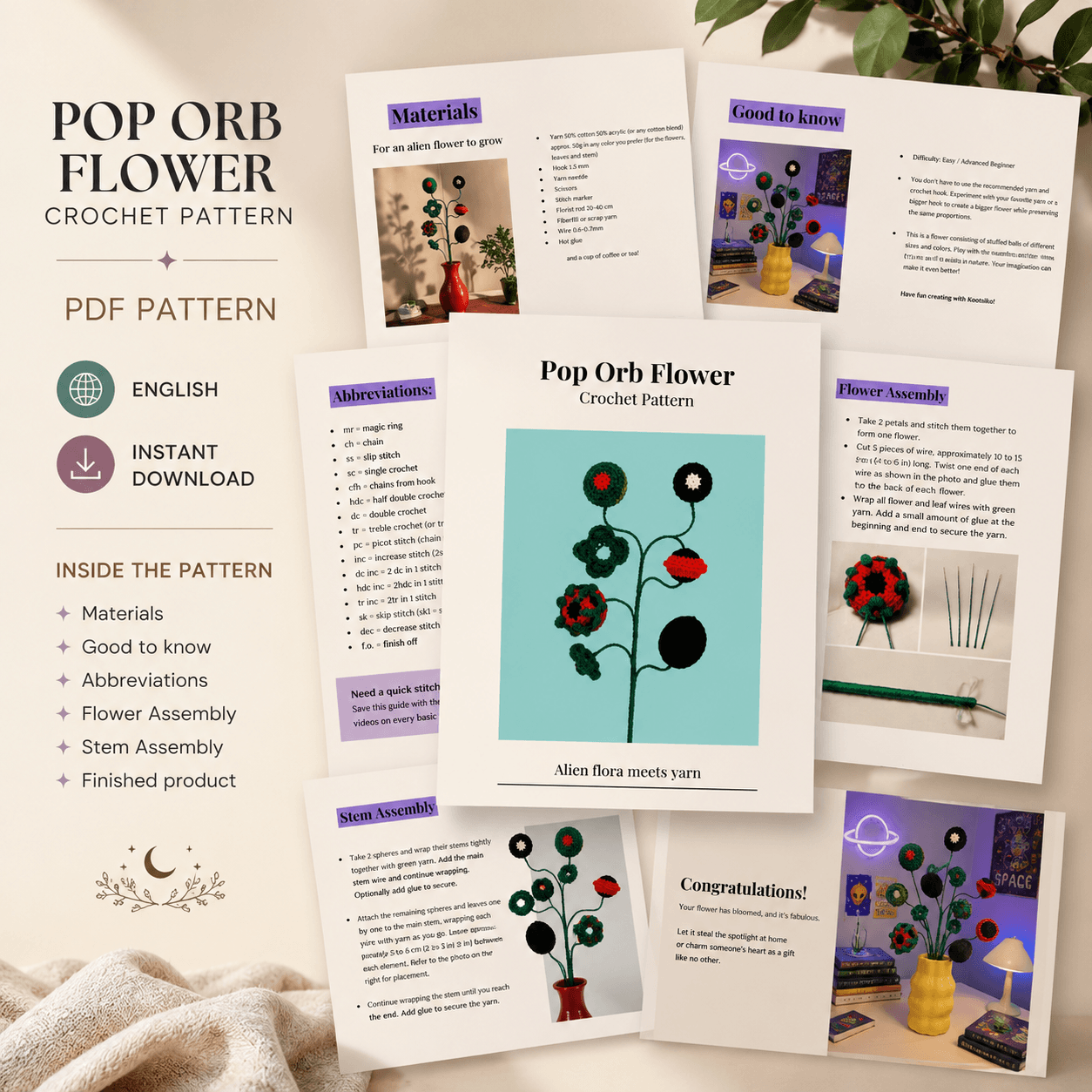
A quick confession before we start: the first flower I ever made from a written pattern looked like it had been through a small personal crisis. So, believing I knew how to read a crochet pattern, I followed a UK pattern using US terms without realizing it. So, every time the pattern asked for a dc (double crochet), I happily made a US double crochet instead of the UK equivalent, which is actually a single crochet. By the time I finished, my delicate little flower had transformed into a giant, wobbly mutant bloom. Naturally, I decided I was a terrible crocheter. Turns out, I wasn’t bad at crochet. I was just speaking American while the pattern was very, very British.
As for the first time I looked at a written crochet pattern, I genuinely thought someone had fallen asleep on their keyboard. “Rnd 1: Ch 2, 6 sc in MR. Join with sl st.” Excuse me… what?
If you’ve ever opened a crochet pattern and immediately questioned whether you accidentally downloaded instructions written in code, you’re not alone. The good news? Crochet patterns aren’t nearly as complicated as they look.
Once you understand a few basic rules, those mysterious strings of letters start making perfect sense. In fact, reading crochet patterns eventually becomes second nature, almost like following a recipe.

So, if you’re new to crochet and wondering how on earth people understand these things, here’s everything you need to know.
Why Crochet Patterns Look So Confusing
Crochet designers use abbreviations to save space. Imagine if every instruction had to say: “Make one single crochet stitch into each of the next three stitches.” Instead of simply: “Sc 3.” Patterns would quickly turn into novels.
Abbreviations make patterns shorter, easier to follow, and more universal. Once you learn the most common ones, you’ll start recognizing them everywhere. Think of it as learning crochet shorthand rather than an entirely new language.
Learn the Crochet Abbreviations First
If crochet patterns are recipes, abbreviations are the ingredients. They’re the foundation of everything. Here are some of the most common abbreviations you’ll come across:
| Abbreviation | Meaning |
|---|---|
| ch | chain |
| sl st (sometimes also “ss”) | slip stitch |
| sc | single crochet |
| hdc | half double crochet |
| dc | double crochet |
| tr | treble crochet |
| st | stitch |
| sts | stitches |
| rep | repeat |
| inc | increase |
| dec | decrease |
| rnd (sometimes also “row”) | round |
| MR (sometimes also “mr”) | magic ring |
The good news is that most designers include an abbreviation list somewhere in their pattern. You don’t have to memorize them all immediately. Keep the list nearby while you crochet. Before long, you’ll stop checking it altogether.
US vs UK Crochet Terms: The Difference That Can Save Your Project
This is one of the biggest mistakes beginners make. Crochet patterns can be written using either US or UK terminology, and the stitch names are not the same. A stitch called one thing in the US can mean something completely different in the UK. For my patterns, I use the US terms however, I had to learn both.
Here’s a quick comparison:
| US Terms | UK Terms |
|---|---|
| single crochet (sc) | double crochet (dc) |
| half double crochet (hdc) | half treble crochet (htr) |
| double crochet (dc) | treble crochet (tr) |
| treble crochet (tr) | double treble crochet (dtr) |
As you can see, using the wrong terminology can dramatically change the size and appearance of your project. So, before you start crocheting, check the pattern notes. Most designers will clearly state whether they’re using US or UK terms.
A helpful clue? If a pattern includes both single crochet and double crochet, it’s almost certainly written in US terminology because UK patterns don’t use the term “single crochet.” It’s a tiny detail that can save you from a lot of confusion later.
How to Read a Crochet Pattern Step by Step
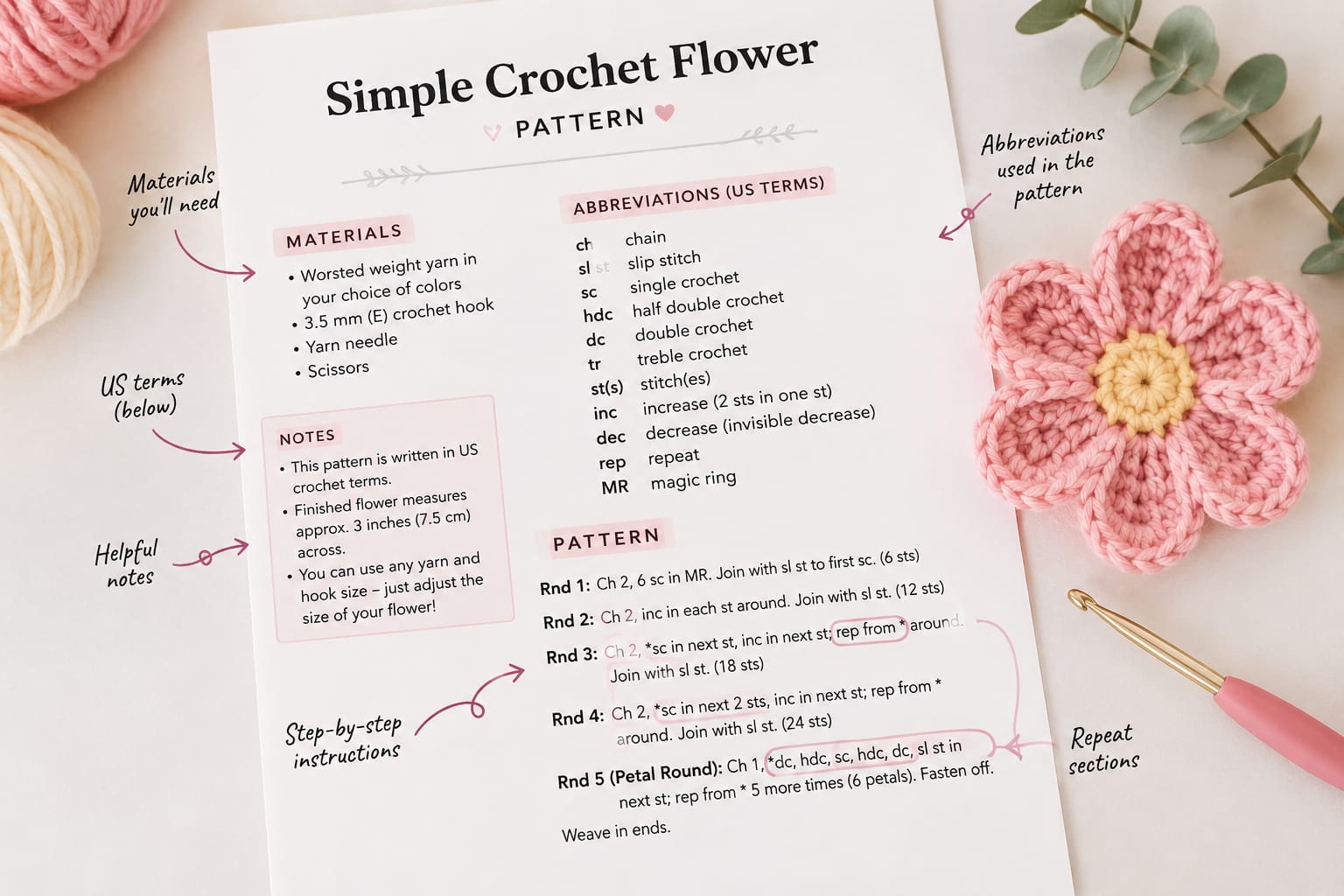
Let’s break down a real example: Rnd 1: Ch2, 6sc in MR. Join with sl st.
At first glance, it might look intimidating. But here’s what it actually means:
- Rnd 1 = Round 1
- Ch 2 = Make two chain stitches
- 6 sc = Work six single crochet stitches
- MR = Into the magic ring
- Join with sl st = Finish the round by joining with a slip stitch
Now, it doesn’t seem nearly as scary. The secret is to slow down and translate each part one piece at a time. You don’t have to understand the whole sentence instantly.
Understanding Repeats, Parentheses, and Asterisks
Another thing that often makes beginners panic is seeing symbols like these:
(sc, inc) × 6
or *Sc in next 3 sts, inc* repeat around.
Take a deep breath. These symbols are actually there to help you. The first example means:
- Make one single crochet.
- Make one increase.
- Repeat that sequence six times.
The second example means:
- Single crochet in the next three stitches.
- Make an increase.
- Repeat that sequence all the way around.
Instead of writing the same instruction over and over again, designers use repeats to keep things tidy. Once you get used to spotting them, repeats become one of your favorite parts of a pattern. Less reading. More crocheting.
Don’t Skip the Pattern Notes
I know it’s tempting. You buy a pattern, scroll straight to the instructions, and skip everything else. But the notes section is there for a reason. Pattern notes often include important information such as:
- Whether the pattern uses US or UK terms
- The finished size
- Recommended yarn and hook sizes
- Special techniques used
- Construction tips
- Gauge information (for wearables)
- When to use stitch markers
Reading these notes can save you hours of frustration.
What If You Still Don’t Understand?
Even experienced crocheters occasionally stare at a line of instructions completely puzzled. If you’re stuck, try these tips:
- Read the instruction out loud.
- Break it into smaller sections.
- Highlight repeats with a pencil or digital highlighter.
- Keep an abbreviation list nearby.
- Look up tutorials for unfamiliar stitches.
- Take a short break and come back with fresh eyes.
Most importantly, don’t assume you’re bad at crochet just because a pattern doesn’t make sense immediately. Reading patterns is a skill. And like every crochet skill, it gets easier with practice.
The More Patterns You Read, The Easier It Gets
The first written pattern you attempt might feel overwhelming. The fifth will feel manageable. The twentieth won’t even slow you down. Eventually, you’ll glance at something like: “Sc 2, inc around.” …and your hands will already know what to do before your brain has finished reading it.
That’s not because some people are naturally better at crochet. It’s simply because they’ve had practice. Every crocheter starts exactly where you are now.
Final Thoughts
Learning how to read a crochet pattern can feel intimidating at first, but it doesn’t take long before everything starts to click. Start by learning the most common abbreviations. Always check whether a pattern uses US or UK terminology. Read the notes before diving in. And give yourself permission to go slowly. You don’t have to memorize everything overnight.
After all, every experienced crocheter was once the person searching online to figure out what “sc” meant. One abbreviation at a time, one pattern at a time, you’ll build confidence. Before you know it, those strange little letters and symbols won’t look like secret code anymore. They’ll look like possibility. And they might just lead you to your next favorite project.
Ready to put your new pattern reading skills into practice? Browse my beginner friendly crochet flower patterns designed to be easy to follow and Netflix compatible. 🙂
Until next bloom,
🖤
Kootsiko
Join my newsletter to receive new patterns, tutorials, and the occasional free surprise.
Read more
How to Spot AI Crochet Patterns Before You Buy
AI crochet patterns are everywhere, but an AI-looking image doesn’t necessarily mean the pattern is …
Birth Month Flowers You Can Crochet: Meanings, Symbolism & Pattern Ideas for Every Month
Looking for the perfect birthday crochet gift? Discover every birth month flower, what each one symb…
How to Choose Flowers for a Crochet Bouquet That Looks Beautiful
A beautiful crochet bouquet isn't just about making pretty flowers. It's about choosing blooms that …
How to Make Realistic Crochet Flowers: 10 Secrets That Bring Yarn to Life
Learn how to make realistic crochet flowers with better yarn choices, petal shaping, wire techniques…
Zephyra – Free Crochet Flower Pattern
Create your own Zephyra crochet flower with this free crochet flower pattern. An easy pinwheel-inspi…
Crochet Flowers With Dark Meanings: 10 Blooms That Tell a Story
Discover crochet flowers with dark meanings and the symbolism behind each bloom. Create handmade bou…
10 Ways to Style Crochet Flowers in a Modern Gothic Home
Think gothic decor means skulls and cobwebs? Think again. Here are 10 stylish ways to decorate a mod…
From Cottagecore to Gothic: My Crochet Poppy Pattern Obsession
One crochet poppy pattern led to another. Discover cute mini bouquets, moody Midnight Poppies and go…
How to Read a Crochet Pattern: A Beginner’s Guide
Learning how to read a crochet pattern can feel like decoding a secret language. In this beginner's …
The Story Behind the Mediterranean Carnation Crochet Pattern
Discover the history, symbolism, and Mediterranean roots behind this realistic Mediterranean Carnati…