
You finish crocheting a flower, attach it to a stem, and watch it slowly bow toward the table. Very dramatic. Not necessarily the look you were going for.

Choosing the best wire for crochet flowers comes down to what you need that wire to do. A small brooch needs discreet shaping. A tall flower needs support. An arched branch needs enough flexibility to bend and enough strength to keep its curve.
For many crochet flower projects, floral stem wire is a practical starting point. Use finer wire for lightweight details and stronger wire for larger flowers, longer stems, and branches that need to hold a deliberate shape. The right choice also depends on the wire material, the weight of your crochet, and how you anchor the finished piece.
First, decide what the wire is supporting
Wire can have several jobs within the same flower:
- Shaping: helping a petal or leaf keep its outline or curve.
- Supporting: carrying the weight of a flower head on a stem.
- Connecting: attaching leaves, buds, or smaller branches to a main stem.
These jobs do not always call for the same thickness. You might use fine wire inside a leaf and a much stronger piece for the stem beneath it.
My Skull Poppy Brooch is a good example of a project suited to light wire. It needs shaping without unnecessary bulk or weight on clothing. Bleeding Heart, Moon Orchid, and Amaryllis illustrate a different need: substantial stems or branches that support the finished construction.
Understanding wire gauge
Wire gauge describes thickness. The higher the gauge number, the thinner the wire. So 26-gauge wire is thinner than 18-gauge wire when both use the same gauge system.
For US readers, AWG means American Wire Gauge. Here are a few common sizes:
| AWG size | Approximate bare-wire diameter |
|---|---|
| 26 | 0.40 mm |
| 24 | 0.51 mm |
| 22 | 0.64 mm |
| 20 | 0.81 mm |
| 18 | 1.02 mm |
| 16 | 1.29 mm |
These are AWG conversions, not a universal floral-wire sizing chart. Some floral suppliers use SWG, a different gauge system. Coatings and paper coverings also add to the outside thickness. Check the listed millimeter diameter and material when comparing products, especially if the package only says gauge.
What thickness should you use for crochet flowers?
The following ranges are starting points for testing, not fixed specifications for every flower or for the Kootsiko patterns mentioned here. Start with your pattern’s materials list whenever it provides a wire size.
| Part or construction | Starting point to consider |
|---|---|
| Small petals, leaves, and lightweight shaping | Fine wire around 0.4–0.5 mm; approximately 26–24 AWG |
| Short stems carrying light flowers | Wire around 0.6–0.8 mm; approximately 22–20 AWG |
| Longer stems or heavier flower heads | Stronger stem wire around 1.0–1.3 mm; approximately 18–16 AWG |
| Large branches or substantial curved stems | Test heavier structural wire or a reinforced construction suited to the pattern |
A long, heavy stem may need more support than these ranges suggest. A small flower on a short stem may need less. Material matters too: two wires with the same diameter can behave differently.
Light wire: the Skull Poppy Brooch

For a small wearable flower, extra thickness can become a nuisance. The wire should help control the shape while staying discreet inside the crochet.
The Skull Poppy Brooch (image below) is a useful example because there is no long stem to support. The construction needs to remain comfortable to wear, with all wire ends secured and covered.
Use the lightest wire that gives the part enough structure. If the edge becomes bulky or difficult to shape neatly, the wire may be thicker than the job requires.
Stronger wire: Bleeding Heart, Moon Orchid, and Amaryllis

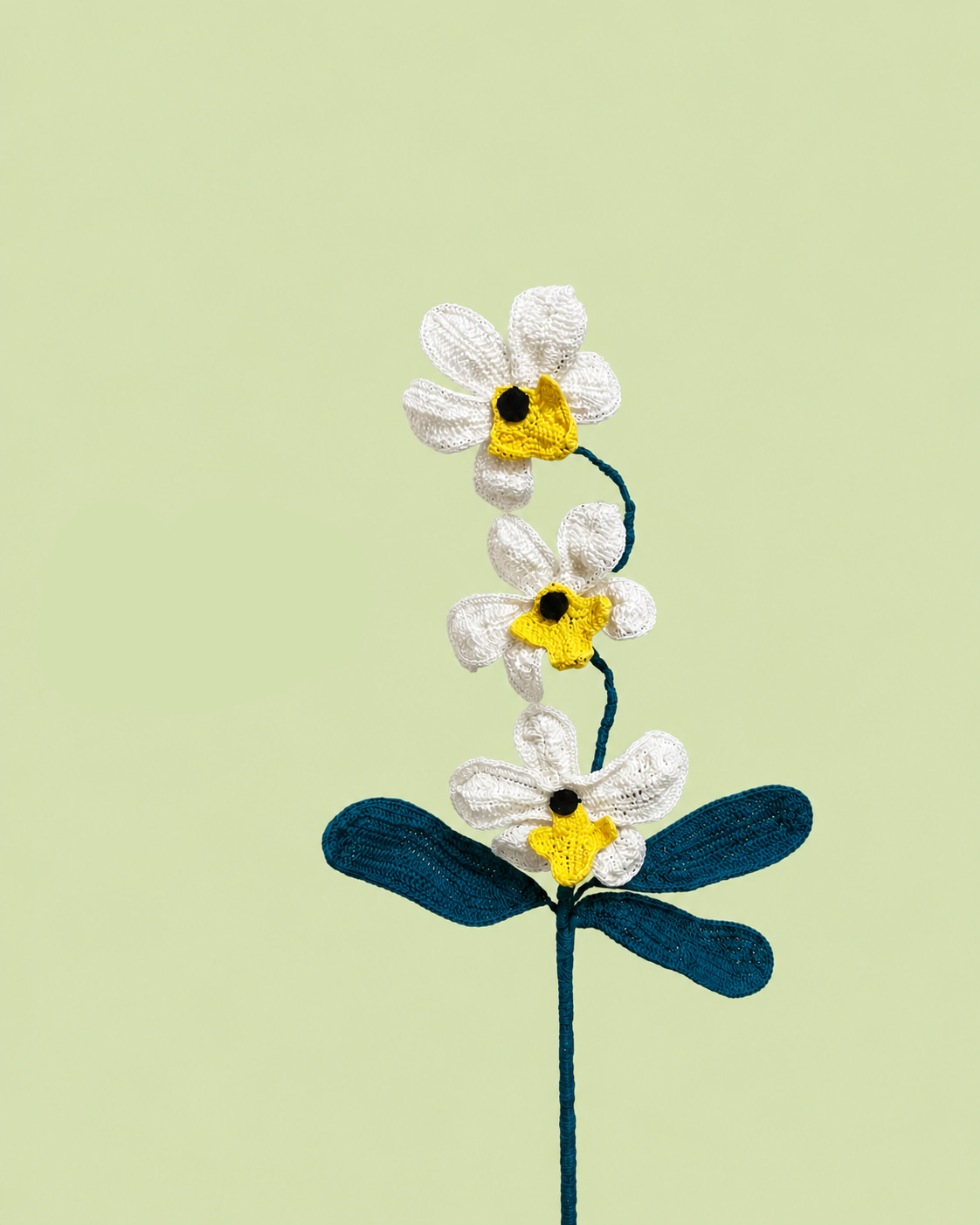

Larger flowers and branching designs ask more of their supports. A stem may need to carry a substantial bloom, several smaller flowers, or weight positioned away from the center.
Bleeding Heart and Moon Orchid are especially useful examples for explaining shaped stems and branches. Amaryllis illustrates why a larger flower construction needs a supportive stem.
The aim is a wire you can shape intentionally that then holds the finished flower in position. Choose and test the support with the actual crocheted pieces attached, rather than judging an empty wire by hand.
Bendable wire still needs strength
Thicker does not automatically mean impossible to bend, and easy to bend does not automatically mean strong enough.
Material and temper affect how wire behaves. Temper describes its hardness: a product labeled dead soft bends more readily than a harder wire of the same material and size. Aluminum craft wire is often easy to shape; steel floral stem wire is another option to evaluate for structural support. Check each product’s description rather than assuming all craft wire behaves alike.
For a curved stem, make the curve you want and test it under the flower’s weight. If it slowly opens out or collapses, you need a stronger support, a shorter unsupported length, or a different construction.
Does a small pot let you use thinner wire?

Sometimes. A small, lightweight flower on a short stem may work well with finer wire when the base is securely anchored.
But the pot only supports the part of the stem held inside it. The exposed section still needs to carry the flower. A tall bloom can droop above a perfectly stable base.
There are also two separate problems to watch for:
- The stem bends: review the wire strength, stem length, and attachment beneath the flower head.
- The whole pot tips: review the base weight, anchoring, and position of the flower over the pot.
Thicker wire alone will not fix a pot that is too light for its arrangement.
Should you choose covered or bare wire?
Floral wire comes with different finishes, including paper coverings and colored coatings. Your choice depends partly on how you will finish the flower.
A covering can provide a useful surface for wrapping. Green finishes may be less noticeable beneath a green stem, while another color may suit a darker design. Bare wire may also work when the construction fully encloses it.
Whatever you choose, check for rough spots and secure the ends before enclosing them in crochet. Paper covering or floral tape does not make a cut end harmless. Use wire cutters suited to the wire, and keep your yarn scissors out of this particular argument.
Test before wrapping the whole stem

Before committing to the final assembly:
- Attach the finished flower temporarily using a method that will not damage the stitches.
- Hold or anchor the stem at the depth you plan to use in the pot or vase.
- Shape the stem into its intended position.
- Add any leaves, buds, or other pieces that contribute weight.
- Set it down and check whether it keeps its shape.
If it droops, adjust the support before covering the entire stem with yarn. This small test is much less annoying than unwrapping a finished stem.
Frequently asked questions
Can I use the same wire for stems and petals?
Sometimes, especially for small, lightweight designs. Larger flowers often benefit from finer wire for shaping individual parts and stronger wire for the main stem.
Can I double thinner wire instead of buying thicker wire?
Doubling or bundling wire can add support, but the result depends on how securely the pieces are held together. It will not necessarily behave like one solid thicker wire. Test the complete construction before finishing it.
Can I use a wooden stick instead?
A wooden dowel or suitable craft stick can work for a straight stem when the pattern allows it. For a curved or poseable stem, wire is the more useful choice. Check cut ends for splinters and cover them appropriately.
Why does my flower droop even with thick wire?
The unsupported stem may be too long, the wire may be too soft, or the attachment under the flower head may be loose. Check where the movement starts before changing the entire stem.

What should I buy first?
Start with the wire specified in your chosen pattern. If you are experimenting with your own flowers, a small pack of fine shaping wire and a small pack of stronger stem wire will let you compare their behavior without buying a drawerful of possibilities.
Choose the wire for the job, then test it with the finished crochet. Your flower can have all the personality you like. Its stem should be dependable.
Until next bloom,
🖤
Kootsiko
Join my newsletter to receive new patterns, tutorials, and the occasional free surprise.
Read more
Crochet Flowers as Gifts: A Thoughtful Choice for Allergies, Pregnancy and Pets
Explore crochet flowers as thoughtful gifts for people sensitive to pollen or floral scents, with pr…
How to Spot AI Crochet Patterns Before You Buy
AI crochet patterns are everywhere, but an AI-looking image doesn’t necessarily mean the pattern is …
Birth Month Flowers You Can Crochet: Meanings, Symbolism & Pattern Ideas for Every Month
Looking for the perfect birthday crochet gift? Discover every birth month flower, what each one symb…
How to Choose Flowers for a Crochet Bouquet That Looks Beautiful
A beautiful crochet bouquet isn't just about making pretty flowers. It's about choosing blooms that …
How to Make Realistic Crochet Flowers: 10 Secrets That Bring Yarn to Life
Learn how to make realistic crochet flowers with better yarn choices, petal shaping, wire techniques…
Zephyra – Free Crochet Flower Pattern
Create your own Zephyra crochet flower with this free crochet flower pattern. An easy pinwheel-inspi…
Crochet Flowers With Dark Meanings: 10 Blooms That Tell a Story
Discover crochet flowers with dark meanings and the symbolism behind each bloom. Create handmade bou…
10 Ways to Style Crochet Flowers in a Modern Gothic Home
Think gothic decor means skulls and cobwebs? Think again. Here are 10 stylish ways to decorate a mod…
From Cottagecore to Gothic: My Crochet Poppy Pattern Obsession
One crochet poppy pattern led to another. Discover cute mini bouquets, moody Midnight Poppies and go…
How to Read a Crochet Pattern: A Beginner’s Guide
Learning how to read a crochet pattern can feel like decoding a secret language. In this beginner's …